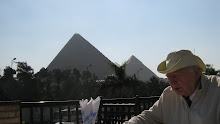
February 26th., 2008
Our visit to the cave churches necessitated rising with the first call to prayer at 5 a.m. to get down town to the Y.W.C.A., the ladies of whom were our guides to the churches. We drove to the Mokattam hills through Garbage City, the city of Cairo’s garbage dwellers and the only access to the churches. Back in 1969 the governor of Cairo, decided to clean up by moving all the garbage collectors, with their ramshackle donkey carts, right out of the city and placed them at the foot of Mokattam. They pick up and take the garbage to their homes for recycling. There they separate it; discarded food for their pigs; the rest they sift and sort; some they sell to dealers. This provides an income for meagre necessities, but few luxuries. However, every Egyptian, including the poorest, has a TV dish on his roof and a cell phone. The former city dump was transformed into the Al-Azar Gardens, which we had previously visited with members of the Y.
Venturing into the Garbage City is quite an adventure, as the “streets” are unpaved, rutted and very narrow with no sidewalk, some so steep that the donkey with its loaded cart needs a helping hand from its master. They’re congested with men, women and children, carts, and now some run down vehicles, that look as though they had been rescued from a dump. Everywhere there is evidence of their faith, as their houses and shops are decorated with crosses and pictures of the Virgin and Coptic Saints. There is a rich aroma of rotting garbage, which clung to our clothes when we got home.
The garbage collectors were first ignored by the church. In fact the priest sent by the patriarch to serve them went, like Jonah, in the opposite direction. But in 1972 a Bible School was opened for the children and from that simple beginning has grown the church, with a school to teach literacy and a clinic for the sick. There is a Canadian connexion to this, in that Rebecca Atallah, the Quebecois wife of Ramez Atallah, the general secretary of the Egyptian Bible Society, teaches in this school. Some of the children came up to us, and spoke to us in French.
The church became well established, but had no where but the open air in which to worship. Some were in the habit of climbing up the mountain to caves in order to pray over the city in quiet and stillness. This was where they were told by the Lord to start to build the church building. The first was of corrugated iron, with no roof. Later they decided to use the caves and a natural amphitheatre in the side of the mountain, and they now have, not one, but four magnificent churches, each distinct in their own special way.
The largest and most spectacular is the amphitheatre, which seats 10,000, perhaps more, with an overhang of the cliff face over the front few rows and the sanctuary, behind the iconostasis, the screen with icons on it, behind which the liturgy is usually celebrated. This church was finished in the mid 1970’s and dedicated by Pope Shenouda III, to the Blessed Virgin Mary and St. Simon the Cobbler, patron saint of the Mokattam. His story I wrote about in January. We were told that every Thursday evening it’s packed with people singing hymns and praising God. They use modern visual aids, with a huge screen.
There are also other churches underground, St. Mark’s, St. Bola’s, and the one we attended the Sunday liturgy in, whose dedication I don’t know. I found St. Bola’s and the church we attended more intimate than the larger churches. In that church there was no iconostasis. Usually the liturgy is celebrated behind closed doors, but it may be a trend now to do it in the open.
The remarkable feature is the carvings in the cliff face; sculpted by a Polish artist, Mario, married to an Egyptian (no one knew his last name.) This is an on going project, though we did not see him at work, being Sunday, but I saw new ones since the last time we visited four years ago. Some had also been painted. They tell the story of Jesus, and Biblical references are also carved in Arabic and English. The one that moved me the most was that of the Resurrection.
After the liturgy people were reluctant to return to the city and picnicked outside the churches, in spite of its not being too warm. Boys played football on the road, even though it wasn’t level ground. We were invited to lunch with the priests, though we weren’t told in advance, and we had taken sandwiches, thermoses for coffee, and a large bag of oranges, I thought to feed 5000; but all that was provided and I noted an orange tree baring fruit in their garden.
Living in Maadi, one of the more desirable parts of Cairo, one doesn’t see too much poverty. Going to Mokattam was truly an eye opener. It was a moving experience to see what had been done with so limited means. The people of these churches, like St. Simon the Cobbler, are nobodies, in the eyes of this world. But their gifts had been multiplied. The churches and the carvings are such a marvellous monument to their faith. What a lasting witness to their compatriots and to the world! The ladies of the Y told us that when Bill Clinton came to see them, his jaw dropped and he said that he had never seen such faith in America. I haven’t either in Canada. I call them a Wow! experience (folk in St. George’s, Lowville, who have attended the School with the Vicar, will know what I mean) and consider them a ‘must see’ to any visitor to Egypt, who still believes in miracles.
Sunday, September 7, 2008

St. Samaan, the Tanner, or Cobbler
Of all the many sites to be seen in Egypt I think the cave churches of Mokattam are a must see. In this essay I shall tell you something of the life of the man to whom they are dedicated, St. Samaan, and in another essay describe, with the help of our new toy, a digital camera, the churches themselves, which are truly magnificent and awe inspiring.
Pope Abram's problem
St. Samaan lived in old Cairo, then known as Babylon, in the 11th Century. However, little is known about him except that he was very short and one eyed and that through his intercession part of the Mokattam Mountain, on the edge of Cairo, was moved. To put this into historical perspective it was after the caliphate of al- Hakim bi-Amr Allah (996-1021) under whom Christians and Jews suffered. He was the caliph who in 1009 destroyed the Church of the Holy Sepulchre in Jerusalem, which sparked the Crusades. However, he disappeared riding his donkey in the Mokattam hills, and was never seen again. His followers, the Druze, still believe that he was hidden away by God, and will return on judgment day. Following him, however, there was a period of enlightenment, especially during the lengthy reign of al-Mustansir (1036-1094) who was a man of great learning, and under him people of all faiths enjoyed a period of tranquility. He enjoyed literary conversation with both Jewish and Christian leaders, but stipulated that there be no acrimony. Once the pontiff, Pope Abram Ibn Zaran, the Syrian, stretched the line a bit by quoting Isaiah 1.3—"The ox knows his owner, and the ass his master's crib: but Israel does not know, my people do not consider"—and suggested that even the animals had greater understanding of God than the Jews. This so infuriated the rabbi that he conceived a plan to retaliate. At their next meeting he suggested to the caliph that he invite the pope to move Mokattam Mountain because his Lord had said that if he had the faith the size of a mustard seed he could so do it. This seemed a fair challenge, so the caliph gave him the order to move the eastern part of the mountain, or else to abandon Christianity for Islam. He had after all broken the ground rule that there be no acrimony.
This put such fear into Abram's heart that he asked the caliph for three day's grace. He called the whole church to fast and to pray. On the third night the Virgin appeared to him. Appearances of the Virgin are not uncommon in Egypt. After all she came here on her flight from Herod. She told him to go out into the market place and there he would find a short, one eyed, man carrying a water pot, and that through his prayer the mountain would be moved.
Abram finds Samaan
This he did before anybody else was up, and found Samaan delivering water to the sick and needy. He told him his mission, but Samaan immediately excused himself, saying that he could do no such thing because he was such a sinful man. He told the pope he was only a cobbler; he started his day by taking water to the sick and elderly, who could not go out to fetch water for themselves, and then he worked through the heat of the day, and in the evening he enjoyed a simple meal with his friends. He said that once, when he was making a pair of shoes for a young lady he noted how beautiful she was, and that he desired her very much, so he stuck his awl into his right eye, in response to the Lord's warning: "...if thy right eye offend thee, pluck it out, and cast it from thee," which accounted for his one eye. Nevertheless he eventually consented to the pope's persuasion, and pope Abram called everyone to the mountain. They all gathered, and Samaan said that he would stand behind the pope, so that nobody would suspect him of performing the miracle. He did so; he prayed, and the miracle happened. The mountain moved. The pope turned around to look for Samaan, but Samaan wasn't there. Caliph al-Mustansir was so impressed by this that he paid out money for major structural repairs to several churches, including the Virgin's church, now known as 'the Hanging Church' in Old Cairo, because it was erected in the 4th. Century, suspended upon old Roman foundations, another must see.
Left-handed justice
No one knows anything more of Samaan, but he came to be venerated by Copts. It's not even known when he died or where he was buried. It's assumed that he would have been buried near the Virgin's church. Some centuries later some popes wished to be buried close to him. From this, recently archeologists think they have located his grave, disinterred the remains, and his 'relics' have been placed in three different churches, one of which is in the cave church at Mokattam, where he performed the miracle. Copts revere the relics of their saints.
This story of Samaan the Tanner, or Cobbler, illustrates what Robert Farrar Capon calls 'left-handed justice;' God does things through those who are weak, rather than strong. In contrast pope Abram in taunting the rabbi was exhibiting right handed power. That's not the way God works. To the skeptical North American this may seem all mythical hog-wash, but in Egypt this story of St. Saaman is on a par with the Scriptures. Something happened; faithful Copts believe it to have been a miracle, and they observe a three day fast tacked before the Advent fast to commemorate it. They also take fasting very seriously. The take home lesson is that God does indeed remove mountains if we allow him to do it his way, and not ours.
Pope Abram's problem
St. Samaan lived in old Cairo, then known as Babylon, in the 11th Century. However, little is known about him except that he was very short and one eyed and that through his intercession part of the Mokattam Mountain, on the edge of Cairo, was moved. To put this into historical perspective it was after the caliphate of al- Hakim bi-Amr Allah (996-1021) under whom Christians and Jews suffered. He was the caliph who in 1009 destroyed the Church of the Holy Sepulchre in Jerusalem, which sparked the Crusades. However, he disappeared riding his donkey in the Mokattam hills, and was never seen again. His followers, the Druze, still believe that he was hidden away by God, and will return on judgment day. Following him, however, there was a period of enlightenment, especially during the lengthy reign of al-Mustansir (1036-1094) who was a man of great learning, and under him people of all faiths enjoyed a period of tranquility. He enjoyed literary conversation with both Jewish and Christian leaders, but stipulated that there be no acrimony. Once the pontiff, Pope Abram Ibn Zaran, the Syrian, stretched the line a bit by quoting Isaiah 1.3—"The ox knows his owner, and the ass his master's crib: but Israel does not know, my people do not consider"—and suggested that even the animals had greater understanding of God than the Jews. This so infuriated the rabbi that he conceived a plan to retaliate. At their next meeting he suggested to the caliph that he invite the pope to move Mokattam Mountain because his Lord had said that if he had the faith the size of a mustard seed he could so do it. This seemed a fair challenge, so the caliph gave him the order to move the eastern part of the mountain, or else to abandon Christianity for Islam. He had after all broken the ground rule that there be no acrimony.
This put such fear into Abram's heart that he asked the caliph for three day's grace. He called the whole church to fast and to pray. On the third night the Virgin appeared to him. Appearances of the Virgin are not uncommon in Egypt. After all she came here on her flight from Herod. She told him to go out into the market place and there he would find a short, one eyed, man carrying a water pot, and that through his prayer the mountain would be moved.
Abram finds Samaan
This he did before anybody else was up, and found Samaan delivering water to the sick and needy. He told him his mission, but Samaan immediately excused himself, saying that he could do no such thing because he was such a sinful man. He told the pope he was only a cobbler; he started his day by taking water to the sick and elderly, who could not go out to fetch water for themselves, and then he worked through the heat of the day, and in the evening he enjoyed a simple meal with his friends. He said that once, when he was making a pair of shoes for a young lady he noted how beautiful she was, and that he desired her very much, so he stuck his awl into his right eye, in response to the Lord's warning: "...if thy right eye offend thee, pluck it out, and cast it from thee," which accounted for his one eye. Nevertheless he eventually consented to the pope's persuasion, and pope Abram called everyone to the mountain. They all gathered, and Samaan said that he would stand behind the pope, so that nobody would suspect him of performing the miracle. He did so; he prayed, and the miracle happened. The mountain moved. The pope turned around to look for Samaan, but Samaan wasn't there. Caliph al-Mustansir was so impressed by this that he paid out money for major structural repairs to several churches, including the Virgin's church, now known as 'the Hanging Church' in Old Cairo, because it was erected in the 4th. Century, suspended upon old Roman foundations, another must see.
Left-handed justice
No one knows anything more of Samaan, but he came to be venerated by Copts. It's not even known when he died or where he was buried. It's assumed that he would have been buried near the Virgin's church. Some centuries later some popes wished to be buried close to him. From this, recently archeologists think they have located his grave, disinterred the remains, and his 'relics' have been placed in three different churches, one of which is in the cave church at Mokattam, where he performed the miracle. Copts revere the relics of their saints.
This story of Samaan the Tanner, or Cobbler, illustrates what Robert Farrar Capon calls 'left-handed justice;' God does things through those who are weak, rather than strong. In contrast pope Abram in taunting the rabbi was exhibiting right handed power. That's not the way God works. To the skeptical North American this may seem all mythical hog-wash, but in Egypt this story of St. Saaman is on a par with the Scriptures. Something happened; faithful Copts believe it to have been a miracle, and they observe a three day fast tacked before the Advent fast to commemorate it. They also take fasting very seriously. The take home lesson is that God does indeed remove mountains if we allow him to do it his way, and not ours.
Who are the Copts?
1. Introduction
It is too simplistic to say that the Copts are that part of the Christian church in Egypt. To understand who they really are, one has to understand a bit of history, and their history goes back a long way, about 6000 years. They are the descendents of the pharaohs and all those who lived on the banks of the Nile, who built the pyramids and the sphinx. Their language was written in hieroglyphics, which we see in their tombs with pictures of their everyday life. In 332 B.C. Alexander the Great conquered Egypt and established the city of Alexandria, over which the Greek-Macedonian pharaohs, the Ptolemy’s, ruled. The language of the educated people became Greek, but the ordinary person still spoke his language, Coptic. The word Copt is derived from the Greek for Egypt, Aigiptos, the ‘gipt’ becoming Copt. They adopted the Greek alphabet, with four extra letters to accommodate four consonants in their language that were not in Greek. Alexandria became the great centre of learning in the Mediterranean world, superseding even Athens. The library of Alexandria was famous throughout the world. It attracted people from all over the then known world, including a large number of Jews, originally displaced by the Babylonians. Around 250 B.C. the Old Testament was translated into Greek by about 70 scholars, the reason for its being called the Septuagint. The Ptolemaic period ended in 30 B.C. with the Roman invasion by Anthony. However, the chief language remained Greek, or rather a common form of it spoken throughout the Mediterranean world, now known as Koine Greek. This is the language in which the New Testament was written. The Romans, unlike the Greek-Macedonians, conquered all of Egypt and established fortified settlements down the whole length of the Nile, and Roman ruins are to be found as far south as Assuit.
2. Early Christian period
Egypt was very fertile soil for Christianity to take root. It is believed that Mark arrived in Alexandria in A.D. 41, and preached throughout Egypt till his martyrdom on Easter Sunday 68. There is a friendly rivalry between the sees of Assuit and Alexandria as to which had the Gospel first. An elderly priest in St. George’s church, Assuit, told me that Mark travelled over the desert from Libya to Assuit, then down the Nile to Alexandria. Whoever it was, Alexandria became the dominant city, because of its previous claim to being the great centre of learning. The modern city of Cairo was then only a collection of villages with a Roman colony, named Babylon (there is part of down town Cairo called Babylouk, and, even today, that part of old Cairo, where the churches are, is called Babylon) and 1 Peter 5.13 suggests that Peter may have visited the Roman colony with Mark, and may have written his first letter from there, or so Egyptian Christians believe today. Who really knows?
However, the most important visitor to Egypt was not Mark, but Jesus himself, as an infant after the slaughter of the Holy Innocents. To the Copt the story of the flight into Egypt does not begin with Matthew 2, but rather with Isaiah 19. This chapter begins:
The burden against Egypt. Behold, the LORD rides on a swift cloud, And will come into Egypt; The idols of Egypt will totter at His presence, And the heart of Egypt will melt in its midst.
This is the prophesy of the Lord’s visiting Egypt, born on a swift cloud, His holy mother, as Copts have interpreted it, and the idols of Egypt, those of the Pharaonic religion, falling in his presence. There are numerous traditions of the child Jesus entering an Egyptian temple and the gods falling on their faces. The heart of Egypt shall melt meaning that there will be nothing remaining of the old religion in the light of the Gospel. Chapter 19 continues with a series of curses upon the old religion, but the mood changes.
In that day there will be an altar to the LORD in the midst of the land of Egypt, and a pillar to the LORD at its border.
The chapter concludes:
In that day Israel will be one of three with Egypt and Assyria--a blessing in the midst of the land, whom the LORD of hosts shall bless, saying, "Blessed is Egypt My people, and Assyria the work of My hands, and Israel My inheritance."
Blessed is Egypt my people is the one promise that every Egyptian holds very dearly and cherishes it in his or her heart, for no other nation, except Palestine, has been blessed by God in this way, with His own presence. Last winter we made three ‘pilgrimages’ to those parts of Egypt reputed to have been visited by the Holy Family.
Alexandria became the centre of Christian learning with such names as Cyprian, Origen and the one that we all know of, Athenasius, who defined the apostolic faith at the Council of Nicea, 325, in the creed which we call the Nicene Creed. That was a high water mark in church history. Perhaps a low water mark was the Council of Chalcedon of 451. At that point the Egyptian church was ostracized by the remainder of the church over a dispute over the person of Jesus Christ. Was the Jesus of history the same person as the Christ whom we worship? The same dispute has been raised by so-called scholars in the church today. The Egyptians said emphatically Yes he was, or rather is, and were known as the Monophesites, from the Greek for ‘one nature.’ They were opposed by Nestorius, a patriarch of Constantinople, and his followers, who said that Jesus had two natures. The fight was so rancorous that the Egyptians were eliminated from any further discussion or council in the church. We saw in the church in Sakha, a town in the Delta, the supposed relics of Bishop Severus, who as patriarch of Antioch, instructed his monks to kill Nestorians in Alexandria. Interestingly, there has been reconciliation between the Coptic Church and all the Western churches over this issue, but not with the Eastern Orthodox Churches, which, though never Nestorian, still do not wish to heal the wounds between themselves and Coptic Christians. There may have been politics behind the fight, since Constantine established Constantinople, which became the dominant centre of Christianity in the East, superseding Alexandria and that other Biblical see of Antioch, in which the disciples of Jesus were first called Christians, and so there may have been no small rivalry. One monk at the Mar Makarios, or St. Makarios, monastery, off the desert road between Cairo and Alexandria, facetiously told me that there were seven candidates to be the Pope in Rome, and the Egyptian was eliminated on the first ballot! Disputes in the church are not a modern phenomenon.
Who then are the Copts? They are firstly Egyptians descended from Pharaonic times. Many of them are Christians, but the term ‘Copt’ also includes not only those in the Coptic Orthodox Church, but also Catholic Copts and Evangelical Copts, indicating a later Western influence in Egypt. There are also Coptic Orthodox Christians in Ethiopia, not Egyptians. There are Egyptian Copts, no longer Christian, since they have converted to Islam, and Arab Copts, who have converted the other way. So the term is no longer as homogeneous as it once was. For the remainder of this essay, however, by Copt I shall mean those in the Coptic Orthodox Church.
3. The Persecutions
The Coptic Church has suffered persecution as no other. In the first three centuries the whole church was persecuted by the Romans, the most severe being that under the Emperor Diocletian, 284 to 303. In our visit to Samannud, a town in the Delta, we learned that during those years, 8000 from that one town, many of them children, had died rather than to bow to an image of the emperor. One of these was the 12 year-old boy, Abanub, whose relics and icon are preserved in the church. The priest removed them from the case and held them for us to touch, so that we might receive baraka, or blessing. Miracles of healing are attributed to Abanub, especially of sick children. He is also esteemed as an example to them, and people have said that on occasions he has jumped out of his icon to play with them. The church is dedicated to the Virgin Mary and to Saint Abanub, who is commemorated on July 31st, the anniversary of his martyrdom. Many of the faithful make a pilgrimage on that date, and many today are healed through intercession to him. So important is the Diocletian persecution that Copts date there calendar from the year 284, rather than the date of the birth of Christ.
From 451, the Council of Chalcedon, to the Muslim invasion in 640, Egyptian Christians suffered more from their fellow Byzantine Christians, than they did in their subsequent history under Islam, to which we shall return later. Immediately following the invasion, however, Christians did have to put over their doorways: Mohammed is a messenger of God. Jesus is a messenger of God. God is neither begotten, nor does he beget. They also had to pay a tax for protection, not from Muslims, but from their fellow Christians!
4. Monasticism
Perhaps the Egyptian church is best known for the monastic movement. Men and women, wishing to get away from the sinful luxuries of the city, or from the persecutions, took themselves off to live in the deserts, some as hermits, some in communities. They lived in caves, and we have visited some at Deir el Hinnis in Upper Egypt. It was quite a climb from the edge of the Nile valley up to the top of the hill, where the caves were carved by nature, several smaller ones where one or two lived, and one larger one which was their church. This was famous since on the walls were the earliest pictorial record known of the Flight into Egypt, not in the best state of preservation. The first known monk was St Anthony, who lived alone near the Red Sea. He started the movement which became widespread throughout the church, and today there are monasteries worldwide, even in the Protestant churches. Monasteries dot the Egyptian landscape, the most famous one being at Muharraq, in Upper Egypt, which we have visited on the trail of the Holy Family. Some of the monks took the Gospel to Europe, from where it came to North America, so we are in their debt. The milkman who delivered our milk had the name Maurice, and I asked why he had a French name, rather than Arabic, thinking he may have had a French mother. He proudly reminded me that Maurice was an Egyptian who had evangelized the Alpine region, and St. Moritz was named after him.
In recent years the numbers of professed monks and nuns has grown substantially, from only 5,000 in the whole of Egypt fifty years ago, to more than 120,000, a greater growth rate than the population of Egypt, which in the same period has grown from 22 million to 69 million. Fr. Philoxenos, whom we met in his monastery of Muharraq, told us that the quality of those professed had increased too, meaning that there were monks and nuns with higher levels of education. He himself had followed his Sunday School instructor, for whom he had a very high regard, into the monastery. When asked what was the attraction to be cloistered, Fr. Philoxenos replied, “I have no needs; I fear nothing.” All his material needs were met, even though he owned nothing. He had the use of a watch and a mobile phone, but he said they belonged to the monastery. He said their days, according to the rule of St. Anthony, were divided between prayer, work and his private life, which was spent alone in his cell. Their day began at 2.30 a.m. and ended with Vespers at four p.m.. There appeared to be no set times for prayer, as in the Benedictine Rule, but he said there were ten masses every day, to fit everybody’s schedule. The masses at al-Muharraq were celebrated in Coptic rather than Arabic, which became the common language of the people after the Arab invasion. Their work varied from working inside the monastery walls, in his case to entertain visitors, to working outside, managing the farms. No one, however, lived outside the walls of the monastery. They all spent a considerable part of their day alone in their cell, most of that time in prayer. After ten years in the order he had been consecrated a priest, which enabled him to say the mass. It was not his decision to become a priest. He had been recommended by his superior, and he had simply obeyed. He said that there was no place in the monastery for anyone unwilling to obey the superior, or to accept celibacy and poverty. If anyone were unhappy with his life as a monk he should commit his mind to the work assigned to him, and work harder at it, and his mind would eventually change. From his demeanor he appeared to be a man extraordinarily content.
5. Relations with non believers
The Muslim invasion of 640 brought some respite to Copts from the constant battles with the remainder of the church. In fact there has been, and is today, a symbiotic relationship between Islam and the Coptic Church. Except for a brief period in the 11th century, Muslims and Christians have co-existed in Egypt exceptionally well. In 969 there was a second Muslim invasion by the Fatimids, direct descendents of the Prophet Mohammed. They founded the city of Cairo, making it the capital of Egypt, and in 970 they founded there the al-Azhar mosque, which became, and still is today, the centre of Islamic studies in the Muslim world. The patriarch of Alexandria also moved to Cairo, even though he retained the title as patriarch of Alexandria. However, in 1016 Caliph al-Hakim (996-1021 – the same man, who in 1009 had ordered the destruction of the church of the Holy Sepulcher in Jerusalem) declared himself to be the earthly incarnation of God, which created some problems for Christians, and many lost their lives. After his death Christians were treated with greater consideration and held high positions in the governments of the Fatimids, and all subsequent Islamic dynasties, right up to the present time. Not even under salâhu d-din yussuf , or Saladin, a Kurd who was born in Tikrit, modern Iraq, in 1138 and died in Damascus in 1193, did the Christians in Egypt suffer as they had under Caliph al-Hakim. It was Saladin who suppressed the Fadimid rulers of Egypt in 1171, and built his palace, the Citadel, which still stands overlooking Cairo today. He also captured Jerusalem in 1187. So great was the divide between the Coptic church and the Western churches that in 1250 they did not go to the aid of the ill fated 7th Crusade of Louis IX of France, the Crusader “saint,” who got bogged down in the streets of the delta city of Mansoura.
Although relations between the leaders of Islam and the church are very cordial, that in the villages has not always been so. These are exacerbated by fiery tempers, and innocent people, on both sides, do get murdered. However, tempers in Egypt do quickly calm down and everybody gets on with their life, even though there may be some smoldering resentment. These stories are often grossly exaggerated in the media. An example of a recent dispute is the case of a holy tree. Just south of Gebel el-Teir, towards Upper Egypt, we saw about a four foot length of a dead trunk of a tree lying on its side on the edge of the road. This was supposed to have been one of several trees that worshiped the Lord, as he passed, bowing their branches to him. However, the church tradition here was less than twenty years old. The tree was no doubt considerably older, (but it did not look to be 2000 years old) but did not attract anyone’s attention till about twenty years ago. During its time as a holy tree it received much veneration from pilgrims, both Christian and Muslim, and the local farmers benefited from the tips left behind. Then just four years ago it was cut down. Some Westernized Copts and the Western media were quick to charge that Muslims wished to erase the Coptic identity from the area. However, Dr. Cornelis Hulsman, a Dutchman, who escorted us on our Holy Family pilgrimages, went there to determine for himself what really had happened. By interviewing all the parties, the priest of the village, government officials and the local farmers, he discovered that a squatter on the land, on which the tree was growing, had heard that the government might put a fence around it, as one might around a heritage site, and he was afraid that he might lose what little land he had to grow his meager amount of food for himself and his family on, as there would be no compensation. There have been some disputes in the villages with more serious consequences, but it is not a systematic persecution as in the days of the emperor Diocletian or Caliph al-Hakim.
6. The Enlightenment, or lack of it
The Egyptian church, being isolated by its geography and history from the West, has never suffered from the so called Enlightenment. Evidence and reason play no part in the faith of the church. There are numerous holy trees that have bowed to the Lord. In the church at Sakha we saw a stone on which the Lord is supposed to have left an imprint of his foot. At Gebel el-Teir he is supposed to have left an imprint of his hand, but local people say that it was either stolen by the Crusaders, or by the English, and is now in the British Museum. There is a belief that Christ after his resurrection went with his disciples to Muharraq to plant the altar that was foretold by Isaiah that there would be an altar of the Lord in the midst of Egypt. (Muharraq is geographically in the middle of Egypt.) To a Western observer, such as myself, all this borders on the incredulous. Dr. Cornelis Hulsman, our tour leader, had previously discussed the skepticism of Western observers with the priest of Samannud, who replied:
It is possible to believe almost anything as long as it is not against the Bible and dogmas of the church. The Coptic Orthodox faith is not intellectual. It is more feeling; believing with your heart. That is not related to someone’s education. Many educated Copts believe with their heart.
Father Philoxenos, whom we have met before, expressed it this way:
Not every fact of history is recorded in historical documents...We first depend on the Bible, then we have the doctrines of the apostles, and the third source is the tradition. These are the three sources of faith of the Coptic Orthodox Church.
You see, Coptic people are a very religious people. We have a strong belief in the Bible, in the church, the sayings of the church, and the history of the church. We can’t deny that there are many stories that are exaggerated. We don’t deny this. But we have faith in our church fathers and in what they say. This is a very strong source for the people of Egypt.
The first source we depend on is faith. If historical evidence adds something that confirms it, it is fine, it is acceptable. If it doesn’t, it doesn’t matter because I already have the faith in my heart.
...We are not talking about a research or a Ph.D. on the Holy Family. We are talking about faith, blessings, miracles, about something spiritual...But this is not accepted in the Western world. They ask for documents, proof, and if you don’t have proof it can’t be true. That is a different way of thinking.
In correspondence with Dr. Hulsman since our trips he wrote that Bishop Thomas, of al-Qussia, with whom we stayed in his diocesan guest house, made the comment that Copts have added through the centuries “salt and pepper” to their stories, to make the traditions more attractive for listeners. They may term themselves “salt and pepper Christians,” but they are Christians none the less, even though they do think so very differently from us.
What do modern day Copts teach the faithful? We had a “fireside” chat, but with no fire, from Bishop Thomas on servant hood, which he said was being in Christ. He spoke of it as being totally immersed in Christ, as if God says: You are in me, and I am in you, quoting John 14:20. He asked if these words were merely symbolic, or actual. He illustrated his answer by floating a glass in a jug of water. By filling the glass with water it sank to the bottom. As the glass was filled with water, we needed to be filled with Christ, the living water, and totally immersed in him. He said that this would change our whole identity; we will become bigger (the glass looked larger in the jug); our vision will change; our lives will become more stable, unmoved when the rest of the world is shaking, and he shook the jug and the glass hardly moved. He said this was not just fantasy, but reality. With our new identity it would even be possible to love our enemies, and only thus could we serve them. When someone asked how this could happen, he replied that we are born to be surrounded by God with his image imprinted in us. But what prevents it is that we prefer the temporal security of the world to the eternal security that God alone can give. This teaching complemented what Fr. Philoxenus had told us earlier; that he lacked nothing and that he feared nothing. The true servant has turned his back on the security the world offers to receive only that which God offers, and his life has been totally satisfied. The bishop repeated several times that only in Christ could he love his enemies.
7. Coptic Worship
How do Copts worship? We attended the Palm Sunday liturgy at Saranka, a predominantly Christian village just a few kilometers from al-Qussia, where it was still possible to hold the procession of palms out doors. There was a lot of excitement as we processed through the narrow unpaved street, waving palm branches. I half expected Bishop Thomas to ride a donkey, but he walked ahead of us. When we arrived in the church, the front two rows were reserved for his party, ourselves and a few others. Behind us on both sides of the church were all men, no women. Some ladies were up in the gallery, but most were not allowed into the church at all. There would have not been enough room for everybody. There was one nun who was allowed in. At the time of the communion, first the men all filed one by one through a door on the left side of the iconostasis, (the screen in the front of the church with a lot of icons on it, separating the body of the church from the sanctuary, where the priests celebrate the liturgy) and then only the women were allowed into the church and they went through a door on the right side, and, after communion, outside again through a side door, back into the courtyard. All the women and girls were dressed in their best Sunday outfits, but the men wore their galabeahs. There was a strong odour in the church of their donkeys, stronger even than the sweet smell of the incense. At the time of the peace I touched many rough and calloused hands, and it occurred to me that perhaps the Lord’s hands were similarly calloused. The lines on their faces told me that theirs was a physically rough life. These were tough men. I felt intimidated by them. If the Lord Jesus had been like them, Gentle Jesus, meek and mild would be far, far from the truth. We began the worship at 7.30 and it ended around noon. This was unusually long, but three hours is the average time for a liturgy.
8. Conclusion
So, who are the Copts? They are an ancient people who became Christian very early in the history of the church. For very complicated reasons they became separated from the rest of the church, both Western and Eastern. Although there has been some rapprochement with the West, there has been very little with the East, in spite of the fact that in many respects they are so very similar. They have, however, learned how to live with Islam, not by compromise of the faith, nor by confrontational Jihad, the only way we in the West know how to combat Islam, but by servant hood. This is the essence of the Good News that Jesus commissioned us to take to the world; but how do we get this across to those who do not see things as we do? A former Anglican bishop of Cairo, Kenneth Cragg, used to preach and write about this difficult question. He said that the best example of church evangelism in a hostile environment was that of the Coptic Church of Egypt, a servant church. A servant church is perhaps a doormat on which those whom it serves clean their feet. This is anathema to our inflated Western egos; but it is Christ like, is it not, who at the Last Supper washed his disciples’ feet. There, I think, they have much to teach us, for this, how to be a servant, basically, is the teaching of Jesus.
It is too simplistic to say that the Copts are that part of the Christian church in Egypt. To understand who they really are, one has to understand a bit of history, and their history goes back a long way, about 6000 years. They are the descendents of the pharaohs and all those who lived on the banks of the Nile, who built the pyramids and the sphinx. Their language was written in hieroglyphics, which we see in their tombs with pictures of their everyday life. In 332 B.C. Alexander the Great conquered Egypt and established the city of Alexandria, over which the Greek-Macedonian pharaohs, the Ptolemy’s, ruled. The language of the educated people became Greek, but the ordinary person still spoke his language, Coptic. The word Copt is derived from the Greek for Egypt, Aigiptos, the ‘gipt’ becoming Copt. They adopted the Greek alphabet, with four extra letters to accommodate four consonants in their language that were not in Greek. Alexandria became the great centre of learning in the Mediterranean world, superseding even Athens. The library of Alexandria was famous throughout the world. It attracted people from all over the then known world, including a large number of Jews, originally displaced by the Babylonians. Around 250 B.C. the Old Testament was translated into Greek by about 70 scholars, the reason for its being called the Septuagint. The Ptolemaic period ended in 30 B.C. with the Roman invasion by Anthony. However, the chief language remained Greek, or rather a common form of it spoken throughout the Mediterranean world, now known as Koine Greek. This is the language in which the New Testament was written. The Romans, unlike the Greek-Macedonians, conquered all of Egypt and established fortified settlements down the whole length of the Nile, and Roman ruins are to be found as far south as Assuit.
2. Early Christian period
Egypt was very fertile soil for Christianity to take root. It is believed that Mark arrived in Alexandria in A.D. 41, and preached throughout Egypt till his martyrdom on Easter Sunday 68. There is a friendly rivalry between the sees of Assuit and Alexandria as to which had the Gospel first. An elderly priest in St. George’s church, Assuit, told me that Mark travelled over the desert from Libya to Assuit, then down the Nile to Alexandria. Whoever it was, Alexandria became the dominant city, because of its previous claim to being the great centre of learning. The modern city of Cairo was then only a collection of villages with a Roman colony, named Babylon (there is part of down town Cairo called Babylouk, and, even today, that part of old Cairo, where the churches are, is called Babylon) and 1 Peter 5.13 suggests that Peter may have visited the Roman colony with Mark, and may have written his first letter from there, or so Egyptian Christians believe today. Who really knows?
However, the most important visitor to Egypt was not Mark, but Jesus himself, as an infant after the slaughter of the Holy Innocents. To the Copt the story of the flight into Egypt does not begin with Matthew 2, but rather with Isaiah 19. This chapter begins:
The burden against Egypt. Behold, the LORD rides on a swift cloud, And will come into Egypt; The idols of Egypt will totter at His presence, And the heart of Egypt will melt in its midst.
This is the prophesy of the Lord’s visiting Egypt, born on a swift cloud, His holy mother, as Copts have interpreted it, and the idols of Egypt, those of the Pharaonic religion, falling in his presence. There are numerous traditions of the child Jesus entering an Egyptian temple and the gods falling on their faces. The heart of Egypt shall melt meaning that there will be nothing remaining of the old religion in the light of the Gospel. Chapter 19 continues with a series of curses upon the old religion, but the mood changes.
In that day there will be an altar to the LORD in the midst of the land of Egypt, and a pillar to the LORD at its border.
The chapter concludes:
In that day Israel will be one of three with Egypt and Assyria--a blessing in the midst of the land, whom the LORD of hosts shall bless, saying, "Blessed is Egypt My people, and Assyria the work of My hands, and Israel My inheritance."
Blessed is Egypt my people is the one promise that every Egyptian holds very dearly and cherishes it in his or her heart, for no other nation, except Palestine, has been blessed by God in this way, with His own presence. Last winter we made three ‘pilgrimages’ to those parts of Egypt reputed to have been visited by the Holy Family.
Alexandria became the centre of Christian learning with such names as Cyprian, Origen and the one that we all know of, Athenasius, who defined the apostolic faith at the Council of Nicea, 325, in the creed which we call the Nicene Creed. That was a high water mark in church history. Perhaps a low water mark was the Council of Chalcedon of 451. At that point the Egyptian church was ostracized by the remainder of the church over a dispute over the person of Jesus Christ. Was the Jesus of history the same person as the Christ whom we worship? The same dispute has been raised by so-called scholars in the church today. The Egyptians said emphatically Yes he was, or rather is, and were known as the Monophesites, from the Greek for ‘one nature.’ They were opposed by Nestorius, a patriarch of Constantinople, and his followers, who said that Jesus had two natures. The fight was so rancorous that the Egyptians were eliminated from any further discussion or council in the church. We saw in the church in Sakha, a town in the Delta, the supposed relics of Bishop Severus, who as patriarch of Antioch, instructed his monks to kill Nestorians in Alexandria. Interestingly, there has been reconciliation between the Coptic Church and all the Western churches over this issue, but not with the Eastern Orthodox Churches, which, though never Nestorian, still do not wish to heal the wounds between themselves and Coptic Christians. There may have been politics behind the fight, since Constantine established Constantinople, which became the dominant centre of Christianity in the East, superseding Alexandria and that other Biblical see of Antioch, in which the disciples of Jesus were first called Christians, and so there may have been no small rivalry. One monk at the Mar Makarios, or St. Makarios, monastery, off the desert road between Cairo and Alexandria, facetiously told me that there were seven candidates to be the Pope in Rome, and the Egyptian was eliminated on the first ballot! Disputes in the church are not a modern phenomenon.
Who then are the Copts? They are firstly Egyptians descended from Pharaonic times. Many of them are Christians, but the term ‘Copt’ also includes not only those in the Coptic Orthodox Church, but also Catholic Copts and Evangelical Copts, indicating a later Western influence in Egypt. There are also Coptic Orthodox Christians in Ethiopia, not Egyptians. There are Egyptian Copts, no longer Christian, since they have converted to Islam, and Arab Copts, who have converted the other way. So the term is no longer as homogeneous as it once was. For the remainder of this essay, however, by Copt I shall mean those in the Coptic Orthodox Church.
3. The Persecutions
The Coptic Church has suffered persecution as no other. In the first three centuries the whole church was persecuted by the Romans, the most severe being that under the Emperor Diocletian, 284 to 303. In our visit to Samannud, a town in the Delta, we learned that during those years, 8000 from that one town, many of them children, had died rather than to bow to an image of the emperor. One of these was the 12 year-old boy, Abanub, whose relics and icon are preserved in the church. The priest removed them from the case and held them for us to touch, so that we might receive baraka, or blessing. Miracles of healing are attributed to Abanub, especially of sick children. He is also esteemed as an example to them, and people have said that on occasions he has jumped out of his icon to play with them. The church is dedicated to the Virgin Mary and to Saint Abanub, who is commemorated on July 31st, the anniversary of his martyrdom. Many of the faithful make a pilgrimage on that date, and many today are healed through intercession to him. So important is the Diocletian persecution that Copts date there calendar from the year 284, rather than the date of the birth of Christ.
From 451, the Council of Chalcedon, to the Muslim invasion in 640, Egyptian Christians suffered more from their fellow Byzantine Christians, than they did in their subsequent history under Islam, to which we shall return later. Immediately following the invasion, however, Christians did have to put over their doorways: Mohammed is a messenger of God. Jesus is a messenger of God. God is neither begotten, nor does he beget. They also had to pay a tax for protection, not from Muslims, but from their fellow Christians!
4. Monasticism
Perhaps the Egyptian church is best known for the monastic movement. Men and women, wishing to get away from the sinful luxuries of the city, or from the persecutions, took themselves off to live in the deserts, some as hermits, some in communities. They lived in caves, and we have visited some at Deir el Hinnis in Upper Egypt. It was quite a climb from the edge of the Nile valley up to the top of the hill, where the caves were carved by nature, several smaller ones where one or two lived, and one larger one which was their church. This was famous since on the walls were the earliest pictorial record known of the Flight into Egypt, not in the best state of preservation. The first known monk was St Anthony, who lived alone near the Red Sea. He started the movement which became widespread throughout the church, and today there are monasteries worldwide, even in the Protestant churches. Monasteries dot the Egyptian landscape, the most famous one being at Muharraq, in Upper Egypt, which we have visited on the trail of the Holy Family. Some of the monks took the Gospel to Europe, from where it came to North America, so we are in their debt. The milkman who delivered our milk had the name Maurice, and I asked why he had a French name, rather than Arabic, thinking he may have had a French mother. He proudly reminded me that Maurice was an Egyptian who had evangelized the Alpine region, and St. Moritz was named after him.
In recent years the numbers of professed monks and nuns has grown substantially, from only 5,000 in the whole of Egypt fifty years ago, to more than 120,000, a greater growth rate than the population of Egypt, which in the same period has grown from 22 million to 69 million. Fr. Philoxenos, whom we met in his monastery of Muharraq, told us that the quality of those professed had increased too, meaning that there were monks and nuns with higher levels of education. He himself had followed his Sunday School instructor, for whom he had a very high regard, into the monastery. When asked what was the attraction to be cloistered, Fr. Philoxenos replied, “I have no needs; I fear nothing.” All his material needs were met, even though he owned nothing. He had the use of a watch and a mobile phone, but he said they belonged to the monastery. He said their days, according to the rule of St. Anthony, were divided between prayer, work and his private life, which was spent alone in his cell. Their day began at 2.30 a.m. and ended with Vespers at four p.m.. There appeared to be no set times for prayer, as in the Benedictine Rule, but he said there were ten masses every day, to fit everybody’s schedule. The masses at al-Muharraq were celebrated in Coptic rather than Arabic, which became the common language of the people after the Arab invasion. Their work varied from working inside the monastery walls, in his case to entertain visitors, to working outside, managing the farms. No one, however, lived outside the walls of the monastery. They all spent a considerable part of their day alone in their cell, most of that time in prayer. After ten years in the order he had been consecrated a priest, which enabled him to say the mass. It was not his decision to become a priest. He had been recommended by his superior, and he had simply obeyed. He said that there was no place in the monastery for anyone unwilling to obey the superior, or to accept celibacy and poverty. If anyone were unhappy with his life as a monk he should commit his mind to the work assigned to him, and work harder at it, and his mind would eventually change. From his demeanor he appeared to be a man extraordinarily content.
5. Relations with non believers
The Muslim invasion of 640 brought some respite to Copts from the constant battles with the remainder of the church. In fact there has been, and is today, a symbiotic relationship between Islam and the Coptic Church. Except for a brief period in the 11th century, Muslims and Christians have co-existed in Egypt exceptionally well. In 969 there was a second Muslim invasion by the Fatimids, direct descendents of the Prophet Mohammed. They founded the city of Cairo, making it the capital of Egypt, and in 970 they founded there the al-Azhar mosque, which became, and still is today, the centre of Islamic studies in the Muslim world. The patriarch of Alexandria also moved to Cairo, even though he retained the title as patriarch of Alexandria. However, in 1016 Caliph al-Hakim (996-1021 – the same man, who in 1009 had ordered the destruction of the church of the Holy Sepulcher in Jerusalem) declared himself to be the earthly incarnation of God, which created some problems for Christians, and many lost their lives. After his death Christians were treated with greater consideration and held high positions in the governments of the Fatimids, and all subsequent Islamic dynasties, right up to the present time. Not even under salâhu d-din yussuf , or Saladin, a Kurd who was born in Tikrit, modern Iraq, in 1138 and died in Damascus in 1193, did the Christians in Egypt suffer as they had under Caliph al-Hakim. It was Saladin who suppressed the Fadimid rulers of Egypt in 1171, and built his palace, the Citadel, which still stands overlooking Cairo today. He also captured Jerusalem in 1187. So great was the divide between the Coptic church and the Western churches that in 1250 they did not go to the aid of the ill fated 7th Crusade of Louis IX of France, the Crusader “saint,” who got bogged down in the streets of the delta city of Mansoura.
Although relations between the leaders of Islam and the church are very cordial, that in the villages has not always been so. These are exacerbated by fiery tempers, and innocent people, on both sides, do get murdered. However, tempers in Egypt do quickly calm down and everybody gets on with their life, even though there may be some smoldering resentment. These stories are often grossly exaggerated in the media. An example of a recent dispute is the case of a holy tree. Just south of Gebel el-Teir, towards Upper Egypt, we saw about a four foot length of a dead trunk of a tree lying on its side on the edge of the road. This was supposed to have been one of several trees that worshiped the Lord, as he passed, bowing their branches to him. However, the church tradition here was less than twenty years old. The tree was no doubt considerably older, (but it did not look to be 2000 years old) but did not attract anyone’s attention till about twenty years ago. During its time as a holy tree it received much veneration from pilgrims, both Christian and Muslim, and the local farmers benefited from the tips left behind. Then just four years ago it was cut down. Some Westernized Copts and the Western media were quick to charge that Muslims wished to erase the Coptic identity from the area. However, Dr. Cornelis Hulsman, a Dutchman, who escorted us on our Holy Family pilgrimages, went there to determine for himself what really had happened. By interviewing all the parties, the priest of the village, government officials and the local farmers, he discovered that a squatter on the land, on which the tree was growing, had heard that the government might put a fence around it, as one might around a heritage site, and he was afraid that he might lose what little land he had to grow his meager amount of food for himself and his family on, as there would be no compensation. There have been some disputes in the villages with more serious consequences, but it is not a systematic persecution as in the days of the emperor Diocletian or Caliph al-Hakim.
6. The Enlightenment, or lack of it
The Egyptian church, being isolated by its geography and history from the West, has never suffered from the so called Enlightenment. Evidence and reason play no part in the faith of the church. There are numerous holy trees that have bowed to the Lord. In the church at Sakha we saw a stone on which the Lord is supposed to have left an imprint of his foot. At Gebel el-Teir he is supposed to have left an imprint of his hand, but local people say that it was either stolen by the Crusaders, or by the English, and is now in the British Museum. There is a belief that Christ after his resurrection went with his disciples to Muharraq to plant the altar that was foretold by Isaiah that there would be an altar of the Lord in the midst of Egypt. (Muharraq is geographically in the middle of Egypt.) To a Western observer, such as myself, all this borders on the incredulous. Dr. Cornelis Hulsman, our tour leader, had previously discussed the skepticism of Western observers with the priest of Samannud, who replied:
It is possible to believe almost anything as long as it is not against the Bible and dogmas of the church. The Coptic Orthodox faith is not intellectual. It is more feeling; believing with your heart. That is not related to someone’s education. Many educated Copts believe with their heart.
Father Philoxenos, whom we have met before, expressed it this way:
Not every fact of history is recorded in historical documents...We first depend on the Bible, then we have the doctrines of the apostles, and the third source is the tradition. These are the three sources of faith of the Coptic Orthodox Church.
You see, Coptic people are a very religious people. We have a strong belief in the Bible, in the church, the sayings of the church, and the history of the church. We can’t deny that there are many stories that are exaggerated. We don’t deny this. But we have faith in our church fathers and in what they say. This is a very strong source for the people of Egypt.
The first source we depend on is faith. If historical evidence adds something that confirms it, it is fine, it is acceptable. If it doesn’t, it doesn’t matter because I already have the faith in my heart.
...We are not talking about a research or a Ph.D. on the Holy Family. We are talking about faith, blessings, miracles, about something spiritual...But this is not accepted in the Western world. They ask for documents, proof, and if you don’t have proof it can’t be true. That is a different way of thinking.
In correspondence with Dr. Hulsman since our trips he wrote that Bishop Thomas, of al-Qussia, with whom we stayed in his diocesan guest house, made the comment that Copts have added through the centuries “salt and pepper” to their stories, to make the traditions more attractive for listeners. They may term themselves “salt and pepper Christians,” but they are Christians none the less, even though they do think so very differently from us.
What do modern day Copts teach the faithful? We had a “fireside” chat, but with no fire, from Bishop Thomas on servant hood, which he said was being in Christ. He spoke of it as being totally immersed in Christ, as if God says: You are in me, and I am in you, quoting John 14:20. He asked if these words were merely symbolic, or actual. He illustrated his answer by floating a glass in a jug of water. By filling the glass with water it sank to the bottom. As the glass was filled with water, we needed to be filled with Christ, the living water, and totally immersed in him. He said that this would change our whole identity; we will become bigger (the glass looked larger in the jug); our vision will change; our lives will become more stable, unmoved when the rest of the world is shaking, and he shook the jug and the glass hardly moved. He said this was not just fantasy, but reality. With our new identity it would even be possible to love our enemies, and only thus could we serve them. When someone asked how this could happen, he replied that we are born to be surrounded by God with his image imprinted in us. But what prevents it is that we prefer the temporal security of the world to the eternal security that God alone can give. This teaching complemented what Fr. Philoxenus had told us earlier; that he lacked nothing and that he feared nothing. The true servant has turned his back on the security the world offers to receive only that which God offers, and his life has been totally satisfied. The bishop repeated several times that only in Christ could he love his enemies.
7. Coptic Worship
How do Copts worship? We attended the Palm Sunday liturgy at Saranka, a predominantly Christian village just a few kilometers from al-Qussia, where it was still possible to hold the procession of palms out doors. There was a lot of excitement as we processed through the narrow unpaved street, waving palm branches. I half expected Bishop Thomas to ride a donkey, but he walked ahead of us. When we arrived in the church, the front two rows were reserved for his party, ourselves and a few others. Behind us on both sides of the church were all men, no women. Some ladies were up in the gallery, but most were not allowed into the church at all. There would have not been enough room for everybody. There was one nun who was allowed in. At the time of the communion, first the men all filed one by one through a door on the left side of the iconostasis, (the screen in the front of the church with a lot of icons on it, separating the body of the church from the sanctuary, where the priests celebrate the liturgy) and then only the women were allowed into the church and they went through a door on the right side, and, after communion, outside again through a side door, back into the courtyard. All the women and girls were dressed in their best Sunday outfits, but the men wore their galabeahs. There was a strong odour in the church of their donkeys, stronger even than the sweet smell of the incense. At the time of the peace I touched many rough and calloused hands, and it occurred to me that perhaps the Lord’s hands were similarly calloused. The lines on their faces told me that theirs was a physically rough life. These were tough men. I felt intimidated by them. If the Lord Jesus had been like them, Gentle Jesus, meek and mild would be far, far from the truth. We began the worship at 7.30 and it ended around noon. This was unusually long, but three hours is the average time for a liturgy.
8. Conclusion
So, who are the Copts? They are an ancient people who became Christian very early in the history of the church. For very complicated reasons they became separated from the rest of the church, both Western and Eastern. Although there has been some rapprochement with the West, there has been very little with the East, in spite of the fact that in many respects they are so very similar. They have, however, learned how to live with Islam, not by compromise of the faith, nor by confrontational Jihad, the only way we in the West know how to combat Islam, but by servant hood. This is the essence of the Good News that Jesus commissioned us to take to the world; but how do we get this across to those who do not see things as we do? A former Anglican bishop of Cairo, Kenneth Cragg, used to preach and write about this difficult question. He said that the best example of church evangelism in a hostile environment was that of the Coptic Church of Egypt, a servant church. A servant church is perhaps a doormat on which those whom it serves clean their feet. This is anathema to our inflated Western egos; but it is Christ like, is it not, who at the Last Supper washed his disciples’ feet. There, I think, they have much to teach us, for this, how to be a servant, basically, is the teaching of Jesus.
Impressions of Our Holy Family Pilgrimage to the Governorate of Assiut, Deir al-Muharraq, Al-Qussia, Meir, Assiut, Durunka and Sarakna, from Friday,
Last evening we returned from our third Holy Family Pilgrimage, our second to Upper Egypt, and I wish now to record some of my impressions. I do not wish to do this in the form of a travelog - we went there and we saw that - but to discuss three major themes of the pilgrimage. These were firstly, modern day monasticism in Egypt - we did see both a monastery, Deir al-Muharraq, and a convent, Durunka, and made contact with some of the monks and nuns, as well as Bishop Thomas of al-Qussia, who spoke to us of servanthood; as basically a religious, whether a lay person, priest or bishop, is a servant. Secondly, I should like to discuss the recent mysterious events that have been happening in Upper Egypt. Are they spiritual phenomena or pious fraud? Thirdly, I should like to discuss the role of women in the Coptic Church in Upper Egypt, as what we saw in the church in Sarakna, to our Western eyes, was not very complementary to the church.
The pilgrimage was once again led by Dr. Cornelis Hulsman, Kees, (pronounced Kays) and at least half of the group were members of the Hong Kong Christian Council, which this year is celebrating its 50th anniversary. There were clergy and laity from several different churches in Hong Kong, including the Anglican bishop, Thomas Sou. The other half was a varied assortment of Egyptian, Germans, Austrian, Dutch, Australians, Americans and ourselves, Canadians. During our stay in Upper Egypt we were guests of Bishop Thomas of al-Qussia (Kees frequently had to distinguish between which Bishop Thomas he was alluding to) in his Five Star guest house, which was actually three or four houses adjacent to the church, all joined together, each with a roof top garden, connected to one another by stairs as the roofs were at different levels. There were many varieties of flowering trees and shrubs; many bougainvillaeas of varying hues, jasmine, roses, geraniums, these were the only ones whose names I knew, but there were others. I enjoyed it best in the very early morning, during and after the Call to Prayer, before anyone else was up, and the full moon was still in the sky. On one morning I watched the sun rise above the dusty haze of sand on the horizon. I told the bishop that he had created a thing of beauty, which was true compared with other roof tops around us. He is the first bishop of al-Qussia, consecrated just 15 years ago. He has improved the lives of his people by stressing the need for education. We sat with two teen age girls at our final lunch in the church house at Sarakna; one of them, the parish priest’s daughter, wanted to be a doctor, like her dad before he was ordained, and her friend a pharmacist. Both girls spoke excellent English, which has certainly widened their horizons, and they enjoyed speaking with visitors from such far away places. In introducing his namesake to the congregation of Sarakna at their Palm Sunday liturgy Bishop Thomas said that Hong Kong was a left turn at the next village, which drew a few laughs.
We visited the monastery of Deir al-Muharraq, 327 Kms. south of Cairo, 48 Kms. north of Assiut. It is the holiest site in Egypt, because the monks there believe that the altar in their church is the one referred to in Isaiah 19:19 In that day shall there be an altar to the LORD in the midst of the land of Egypt. We were told repeatedly that the Holy Family had stayed there for six months and five days, the longest duration that they had stayed anywhere in Egypt, and that the Lord himself had returned with his disciples on a cloud to al-Muharraq after his resurrection and consecrated the altar.3 Evidence for these claims are from The Vision of Theophilus, attributed to Theophilus, Patriarch of Alexandria from 385 to 412, who had a vision of the Virgin Mar as a guest at the monastery. Because of this, a pilgrimage to al-Muharraq is considered by Copts to be equivalent to a pilgrimage to Jerusalem, which is not possible these days. At first appearance one is impressed by its immense size. The monastery is very large. I was reminded of the monasteries of Quebec before the anti clerical Quiet Revolution of 40 years ago; they were then occupied by thousands of religious, but are now virtually deserted, and many have closed their doors, perhaps permanently. One cannot help but wonder how much money it takes to run the place, and from where it receives its income. We soon learned that it came from two sources, the same two as the medieval monasteries of Europe; from pilgrims and from the land.
Deir al-Muharraq is in the Nile valley in the centre of very rich farm land. Agriculture is the chief industry, and we saw fields of wheat, alfalfa and grape vines for as far as the eye could see. We saw no up to date farming, only one tractor. Nearly all the farmers rode their donkey into the fields. The alfalfa was cut by hand and fed to the animals, donkeys, goats and sheep, which were in abundance in the villages we passed though and stayed in - a very picturesque scene for us, but probably not so for the people who lived in them. We saw outside the town some wheat being thrashed and winnowed, as in Biblical times.
One enters the Deir al-Muharraq by a most impressive gate that had only been built since Kees’ last visit a year ago. None of the buildings of the monastery appeared to be very old, considering the claims for its antiquity. Most of them were for pilgrims or guests, not for the residents, who lived in cells. We did not see these, but were led to imagine that they were very simple; with only slightly more comfort than the caves we had seen at Deir el-Hinnis, where monks had lived from the fifth century, or on the desert where Anthony started the monastic movement in the third century. At the heart of the monastery was the church, which is known to date from the 12th or 13th century. It is possibly built upon older foundations. The present altar dates only from the 7th century, though Fr. Philoxenos, our guide, said it was built over the one which the Lord had consecrated.
Kees told us that from the Sunday School movement in the Coptic Church, the numbers of professed monks and nuns had grown substantially, from only 5,000 in the whole of Egypt fifty years ago, to more than 120,000, a greater growth rate than the population of Egypt, which in the same period has grown from 22 million to 69 million. Fr. Philoxenos added that the quality of those professed had increased too. He himself had followed his Sunday School instructor, for whom he had a very high regard, into the monastery. Asked what was the attraction to be cloistered, Fr. Philoxenos replied, “I have no needs; I fear nothing.” All his material needs were met, even though he owned nothing. He had the use of a watch and a mobile phone, but he said they belonged to the monastery. He said their days, according to the rule of St. Anthony, were divided between prayer, work and his private life, which was spent alone in his cell. Their day began at 2.30 a.m. and ended with Vespers at four p.m.. There appeared to be no set times for prayer, as in the Benedictine Rule, but he said there were ten masses every day, to fit everybody’s schedule. The masses at al-Muharraq were celebrated in Coptic rather than Arabic, the common language of the people since the Arab invasion. Their work varied from working inside the monastery walls, in his case to entertain visitors, to working outside, managing the farms. No one, however, lived outside the walls of the monastery. They all spent a considerable part of their day alone in their cell, most of that time in prayer. After ten years in the order he had been consecrated a priest, which enabled him to say the mass. It was not his decision to become a priest. He had been recommended by his superior, and he had simply obeyed. He said that there was no place in the monastery for anyone not willing to obey the superior, or to accept celibacy and poverty. If anyone were unhappy with his life as a monk he should commit his mind to the work assigned to him, and work harder at it, and his mind would eventually change. When pressed by Kees, whether there was a way out, or not, he just said that it was between the person, his superior and the Lord, but it seemed that there was no way in the book to break that final vow. Nevertheless Kees reminded him that one man did, and then spread a lot of false rumours in the press about the monastery, as if to suggest it would have been better to have had a prearranged escape route. Fr. Philoxenos admitted that person had hurt them a great deal, but they were later exonerated.
No one asked how they were viewed in the eyes of the Muslim community, although in that part of Upper Egypt the Christians may be in the majority. The Koran makes one reference to monasticism, Surah 57:27, which states:
...We sent after them Jesus the son of Mary, and bestowed on him the Gospel; and we ordained in the hearts of those who followed him compassion and mercy. But the monasticism which they invented for themselves, we did not prescribe for them: We commanded only the seeking for the Good Pleasure of Allah; but that they did not foster as they should have done. Yet we bestowed on those among them who believed their due reward, but many of them are rebellious transgressors.
It may be construed that Islam is in general opposed to monasticism. If it were the Lord saying: “Yet we bestowed on those among them who believed their due reward” that is true for the monastery of al-Muharraq, as it appears to be very richly endowed. However, we did not see any ‘rebellious transgressors’ among them. One thing Father Philoxenos did tell me was that they made no distinction in the choice of tenants on the land, whether Christian or Muslim, and added that some of the Muslim farmers were more productive, and they occasionally had to deprive an unproductive Christian tenant and give it to a productive Muslim. I did not think to ask him whether they ever did it the other way round, and what would happen if they did.
The Egyptian Bishop Thomas, on our second evening as his guests, gave a talk on servanthood, which he said was being in Christ. He spoke of it as being totally immersed in Christ, as if God says: You are in me, and I am in you. quoting John 14:20. He asked if these words were merely symbolic, or actual. He illustrated his answer by floating a glass in a jug of water. By filling the glass with water it sank to the bottom. As the glass was filled with water, we needed to be filled with Christ, the living water, and totally immersed in him. He said that this would change our whole identity; we will become bigger (the glass looked larger in the jug); our vision will change; our lives will become more stable, unmoved when the rest of the world is shaking, and he shook the jug and the glass hardly moved. He said this was not just fantasy, but reality. With our new identity it would even be possible to love our enemies, and only thus could we serve them. When asked how this could happen, he replied that we are born to be surrounded by God with his image imprinted in us. But what prevents it is that we prefer the temporal security of the world to the eternal security that God alone can give. This teaching complemented what Fr. Philoxenus had told us earlier; that he lacked nothing and that he feared nothing. The true servant has turned his back on the security the world offers to receive only that which God offers, and his life has been totally satisfied. The bishop repeated that only in Christ could he love his enemies. I was reminded of Bishop Kenneth Cragg’s saying that in an indifferent or hostile environment the only method of evangelism was servanthood, and he spoke of the Coptic Church being an example to the Western churches. This fireside chat with Bishop Thomas, although there was no real fireplace, being in Egypt, was for me the mountain top experience of the whole weekend; although it did demand a certain amount of faith in the first place to understand his metaphor, being immersed in Christ, even with his illustration of the glass in the jug. I believe that a skeptic with no faith would have been lost, though a child with unlimited faith would pick it up immediately. It would be an excellent illustration for a children’s talk.
The convent of Durunka is about eight Kms. south of Assiut, and is built in the cliffs on the western side of the valley. From the valley floor they look humongously large, buildings built one above the other at different levels, like Tibetan monasteries in the Himalayas. The bus climbed a very steep and windy road. and stopped outside the main gate. We were met by Sister Linda, whom we had been told was a graduate of the American University in Cairo, but upon graduation she had chosen the convent. It was evident from the contentment in her face that she neither lacked anything, nor feared anything. Durunka is also believed by some Copts to be a site which the Holy Family visited, but this tradition is not from the Vision of Theophilus, from the 4th century, as al-Muharraq, but is only about fifty years old, being the vision of Metropolitan Michael, metropolitan of Assiut, whose church we visited on the way to Durunka. Michael must be the oldest active bishop in the world being consecrated in 1946, but he is one of the most astute. What he says goes, and no one dare argue with a metropolitan of such seniority. Al-Muharraq, which, according to the Vision of Theophilus, was the southern most point of the Holy Family’s travel, does not lie in his diocese. By the older tradition they returned to Palestine by way of Buq on the opposite side of the Nile, and from there to Ashmonein, a major Greco-Roman port. However, Metropolitan Michael purports that they first went 56 Kms. further south before proceeding north. The convent of Durunka has a very old foundation, but until Metropolitan Michael it was not supposed to have been a Holy family site, and therefore did not draw pilgrims. By his declaring it a Holy family site it does, and, in fact, attracts many more pilgrims than does al-Muharraq, the holiest site in Egypt; which leads me to the second theme of this essay, the mysterious events at the church of Assiut.
There is very little debate these days that the appearances of the Holy Virgin in 1968 at the church in Matareya, a suburb of Cairo, were genuine. That was the year that St. Mark’s relics were returned to Egypt from Venice and installed in the new St. Mark’s Cathedral in Cairo. It led to a renaissance in the Coptic Church. That is now history. Around that time I saw a picture of the apparition of the Virgin at the church in the Illustrated London News, and it was investigated by the Vatican and deemed genuine, a spiritual phenomenon. For two years from 1999 to 2001 similar appearances have been seen over the dome of St. Mark’s church in Assiut in the form of flashes of light. Kees has investigated these and has visited the church when they have purportedly been seen by the enthusiastic crowd below, who cried out that it was the Virgin. He took with him an American photographer, who did record some light on film, though, strangely, Kees saw nothing. Metropolitan Michael, when presented with this, declared it to be a spiritual phenomenon. Someone else has made a CD of the flashes of light, copies of which the parish priest gave to each one of us. We were also shown them on video by Sister Linda at Durunka. She implicitly believed that they were supra natural. Others, including Kees, are more skeptical. He quoted the eminent scholar on the Coptic Church, Dr. Otto Meinardis, who said that they were a pious fraud. One of our group, Axel Krause, a German free lance photographer living in Egypt, had also tried to photograph them in the past. He thought that they occurred whenever his flash went off, as if there was a light sensor that was stimulated by his flash.
I myself think that it is an open question. Time will tell. We do believe from the Scriptures that there is another infinite sphere that is not bound by natural law, as is space and time of our finite universe. This, for want of a better name, we call heaven, where God is. We cannot describe the infinite with our finite minds, but we try, and some of our descriptions might appear more literal than others. But we do believe that some times, somehow, the infinite invades the finite, as we believe happened at the time of the miracles recorded in the Bible, most notably at the resurrection of Jesus Christ, and it can happen again today, but, admittedly, seldom does. That I can only say by faith. There is no evidence for the resurrection, other than the testimony of the Gospel writers and Paul, which I accept on faith. There are those who say that it was a fraud, and some have gone to great lengths to say that Christianity is not theistic, that there is nothing and nobody out there, which would make such spiritual events impossible. But I for one am not ashamed to confess that there is an out there, and we should be very mindful of what, or rather who, is out there. I say this because I do not believe there would be a church today, 2000 years later, if it were based on fraud; nor do I believe the Lord would bless the work of Metropolitan Michael, if it too were based on fraud. This is not to deny that Christians are rebellious transgressors as the Prophet and the Bible both assert, but I find it hard to believe that they are fraudsters. I am willing to give Metropolitan Michael the benefit of doubt. Even if we do find the paraphernalia for creating such a spectacular light display, the wiring, light sensors and bulbs, I would still not say it was fraud, pious or otherwise, because it was, after all, harmless entertainment – pious entertainment. I doubt that they ever see fireworks in this part of Egypt. I might, however, tell him, if I had the opportunity, Heh Man, That’s not cricket.
Whatever the lighting display was, it certainly created a windfall for Metropolitan Michael. He began the restoration of the convent at Durunka in the 1950s, and since these displays the work has progressed at an accelerated rate, mainly for the benefit of the pilgrims. Durunka has no farm land around it, as has al-Muharraq, so it is totally dependent on income from pilgrims. About half a million go there each year, compared with only two to three hundred thousand to al-Muharraq. Making a pilgrimage is a popular pass time in Egypt, and these two sites are, for the Copts, the most popular.
These displays of lights may indicate a little rivalry between the sees of Assiut and Alexandria, as if Assiut were saying, Everything you can do, I can do better. The priest of St. George’s church told me that St. Mark had brought the Gospel to them first from Libya, and then only later he traveled north by boat to Alexandria, where he planted another church, but he insisted that the church of St. Mark in Assiut was the first. I spoke to Kees about this and he said that it was a local legend for which there was no foundation other than word of mouth. Oral tradition carries a lot of weight in Upper Egypt, as it did before the spoken Word of God was written. Coptic faith is firmly based, not only on the written Word, but also on these other stories, the spoken word, derived from visions and dreams, as we have seen. Provided they not contradict Scripture, as this certainly does not, as there is nothing in the Bible stating clearly where the Holy Family went in Egypt, or that Mark ever came to Egypt, I do not see anything to argue about. It is just a very strong tradition.
The third theme of this essay is the place of women in the church of Upper Egypt, as we saw it. We attended the Palm Sunday liturgy at Sarakna, a predominantly Christian village just a few kilometers from al-Qussia, where it was still possible to have the procession out doors. There was a lot of excitement as we processed through the narrow unpaved street, waving palm branches. I half expected Bishop Thomas to ride a donkey, but he walked ahead of us. When we arrived in the church, the front two rows were reserved for the bishop’s party, which was us and a few others. Behind us on both sides of the church were all men, no women. Some ladies were up in the gallery, but most were not allowed into the church at all. There would have not been enough room for everybody. What disturbed me most was that some younger women wanted to come into the church, but were shooed away by the men who guarded the door. There was one nun who was allowed in. At the time of the communion, first the men all filed one by one through a door on the left side of the iconostasis, and then only the women were allowed into the church and they went through a door on the right side, and, after communion, outside again through a side door. All the women and girls were dressed in their best Sunday outfits, but the men wore their galabeahs, and the strong smell of donkey dung pervaded the church, rather than the incense. At the time of the peace I touched many rough and calloused hands, and it occurred to me that perhaps the Lord’s hands were similar. The lines on their faces told me that theirs was a physically rough life. These were tough men. I felt intimidated by them. If the Lord Jesus had been like them, Gentle Jesus, meek and mild would be far, far from the truth. I am not suggesting that the women are dissatisfied with their subordinate state, as women in the West certainly would be, but I do believe that as they become better educated they will be, and the men will have to accept it. The previous evening one of the Chinese ladies, who was ordained, reproached Bishop Thomas for the fact that women in Egypt were not ordained to the priesthood. He said that women and men simply had different functions, one of which for men was the priesthood. Women had other functions, such as childbearing and the rearing of children. He thanked God that he was a son of a woman, and that he had profound respect for women and the work that they do. He did admit, however, that Egypt was a very male dominated society, and that it is not going to change overnight. That was demonstrated in the church the next day. I do not think that we can throw stones at Egyptians, unless we can say that women are never abused in our own country, which should shut us up on this subject.
It was a full weekend of three packed days, and there were also visits to the tombs of Meir, dating from the Old and Middle Pharaonic Kingdoms. The pictures on the walls were of rural activities such as we had seen in and around the villages. The life of the farmer has not changed much in 5000 years! In marked contrast, we were invited to meet the Governor of Assiut at the Governorate. There they showed us a promotional video about Assiut in Chinese! They gave each one of us the same video, but ours, thankfully, was in English. From its modern buildings, university, roads and bridges, Assiut could be a city in California, but it is in Egypt. Returning to al-Qussia and Sarakna; we went back 5000 years! Perhaps not that many, since Bishop Thomas is encouraging his people to obtain as good an education as they are able. In time there will be less of a contrast, but not for the foreseeable future.
My final impression is of a church living in an extraordinarily difficult situation, bridging 5000 years, and yet not just surviving, but thriving, because they have learned what it really means to serve. Though far from perfect, I believe that the Lord is confirming them, rather than us, with spiritual phenomena, that we with our superior knowledge and wisdom just cannot understand, and therefore reject. Humble service, which we saw demonstrated in the lives of those we met, is the one lesson that the Coptic Church could teach us, if we wished to be taught. I am reminded of the words of St. Paul in the First letter to the Corinthians, chapter 1:
...23 But we preach Christ crucified, unto the Jews a stumbling block, and unto the Greeks foolishness; 24 But unto them which are called, both Jews and Greeks, Christ the power of God, and the wisdom of God. 25 Because the foolishness of God is wiser than men; and the weakness of God is stronger than men. 26 For ye see your calling, brethren, how that not many wise men after the flesh, not many mighty, not many noble, are called: 27 But God hath chosen the foolish things of the world to confound the wise; and God hath chosen the weak things of the world to confound the things which are mighty; 28 And base things of the world, and things which are despised, hath God chosen, yea, and things which are not, to bring to nought things that are: 29 That no flesh should glory in his presence. 30 But of him are ye in Christ Jesus, who of God is made unto us wisdom, and righteousness, and sanctification, and redemption: 31 That, according as it is written, He that glorieth, let him glory in the Lord.
God has chosen the foolish things of this world to confound the wise, and the weak things to confound the strong. I feel the Lord telling us in the West: You think you are so wise and so strong, but I want you to be like my Copts, who really know how to serve. The Coptic Church has no problem with huge vacant church buildings and monasteries that we have in the West. They have the opposite problem, of too small churches for the numbers that wish to crowd into them, and are shooed out. As Bishop Thomas of Hong Kong said, we should all be riding a donkey. If we did this, as Jesus did, as a sign of humility, we might learn something that we could not learn otherwise.
What is the benefit of these Holy Family tours? I believe the chief one is that we have seen Egypt as it was 5000 years ago, or at least as it was before the Islamic invasion, when Christianity was the only way of life in Egypt . We have been visiting Egypt fairly frequently since 1968, but I had never seen Egypt as it was back then. My father had during the war, when he was stationed in Cairo and the Western Desert. He told me that in his time the road from Giza to the pyramids was bordered by fields on either side, (he would not know it today) with ‘the poorest of the poor’ working in them. We have discovered that some of these ‘poorest of the poor’ of Upper Egypt are our brothers and sisters in Christ. Secondly, we have gotten to know something more of the Coptic Church, and the way Copts think. Faith is primary to Reason, and they rely heavily on the spoken word in addition to the written word. And, thirdly, it has been fun just to be with others who are also looking for something more than the usual tourist attraction. We have enjoyed being with them and entering into dialogue with them. Once again we need to thank Dr. Hulsman, Kees, for his vision in organizing these pilgrimages. They are so well organized, with a carefully planned schedule, well written background information given to each member of the party, well chosen places to stay, choice places to eat and lots of drinks and snacks on the tedious five hour bus journey through desert from Cairo and back, as well as food for the mind in his lectures and videos of what we are to see and whom we shall meet - it must involve an enormous amount of planning before hand - that I think that they are a treasure which, sadly, very few actually find.
The pilgrimage was once again led by Dr. Cornelis Hulsman, Kees, (pronounced Kays) and at least half of the group were members of the Hong Kong Christian Council, which this year is celebrating its 50th anniversary. There were clergy and laity from several different churches in Hong Kong, including the Anglican bishop, Thomas Sou. The other half was a varied assortment of Egyptian, Germans, Austrian, Dutch, Australians, Americans and ourselves, Canadians. During our stay in Upper Egypt we were guests of Bishop Thomas of al-Qussia (Kees frequently had to distinguish between which Bishop Thomas he was alluding to) in his Five Star guest house, which was actually three or four houses adjacent to the church, all joined together, each with a roof top garden, connected to one another by stairs as the roofs were at different levels. There were many varieties of flowering trees and shrubs; many bougainvillaeas of varying hues, jasmine, roses, geraniums, these were the only ones whose names I knew, but there were others. I enjoyed it best in the very early morning, during and after the Call to Prayer, before anyone else was up, and the full moon was still in the sky. On one morning I watched the sun rise above the dusty haze of sand on the horizon. I told the bishop that he had created a thing of beauty, which was true compared with other roof tops around us. He is the first bishop of al-Qussia, consecrated just 15 years ago. He has improved the lives of his people by stressing the need for education. We sat with two teen age girls at our final lunch in the church house at Sarakna; one of them, the parish priest’s daughter, wanted to be a doctor, like her dad before he was ordained, and her friend a pharmacist. Both girls spoke excellent English, which has certainly widened their horizons, and they enjoyed speaking with visitors from such far away places. In introducing his namesake to the congregation of Sarakna at their Palm Sunday liturgy Bishop Thomas said that Hong Kong was a left turn at the next village, which drew a few laughs.
We visited the monastery of Deir al-Muharraq, 327 Kms. south of Cairo, 48 Kms. north of Assiut. It is the holiest site in Egypt, because the monks there believe that the altar in their church is the one referred to in Isaiah 19:19 In that day shall there be an altar to the LORD in the midst of the land of Egypt. We were told repeatedly that the Holy Family had stayed there for six months and five days, the longest duration that they had stayed anywhere in Egypt, and that the Lord himself had returned with his disciples on a cloud to al-Muharraq after his resurrection and consecrated the altar.3 Evidence for these claims are from The Vision of Theophilus, attributed to Theophilus, Patriarch of Alexandria from 385 to 412, who had a vision of the Virgin Mar as a guest at the monastery. Because of this, a pilgrimage to al-Muharraq is considered by Copts to be equivalent to a pilgrimage to Jerusalem, which is not possible these days. At first appearance one is impressed by its immense size. The monastery is very large. I was reminded of the monasteries of Quebec before the anti clerical Quiet Revolution of 40 years ago; they were then occupied by thousands of religious, but are now virtually deserted, and many have closed their doors, perhaps permanently. One cannot help but wonder how much money it takes to run the place, and from where it receives its income. We soon learned that it came from two sources, the same two as the medieval monasteries of Europe; from pilgrims and from the land.
Deir al-Muharraq is in the Nile valley in the centre of very rich farm land. Agriculture is the chief industry, and we saw fields of wheat, alfalfa and grape vines for as far as the eye could see. We saw no up to date farming, only one tractor. Nearly all the farmers rode their donkey into the fields. The alfalfa was cut by hand and fed to the animals, donkeys, goats and sheep, which were in abundance in the villages we passed though and stayed in - a very picturesque scene for us, but probably not so for the people who lived in them. We saw outside the town some wheat being thrashed and winnowed, as in Biblical times.
One enters the Deir al-Muharraq by a most impressive gate that had only been built since Kees’ last visit a year ago. None of the buildings of the monastery appeared to be very old, considering the claims for its antiquity. Most of them were for pilgrims or guests, not for the residents, who lived in cells. We did not see these, but were led to imagine that they were very simple; with only slightly more comfort than the caves we had seen at Deir el-Hinnis, where monks had lived from the fifth century, or on the desert where Anthony started the monastic movement in the third century. At the heart of the monastery was the church, which is known to date from the 12th or 13th century. It is possibly built upon older foundations. The present altar dates only from the 7th century, though Fr. Philoxenos, our guide, said it was built over the one which the Lord had consecrated.
Kees told us that from the Sunday School movement in the Coptic Church, the numbers of professed monks and nuns had grown substantially, from only 5,000 in the whole of Egypt fifty years ago, to more than 120,000, a greater growth rate than the population of Egypt, which in the same period has grown from 22 million to 69 million. Fr. Philoxenos added that the quality of those professed had increased too. He himself had followed his Sunday School instructor, for whom he had a very high regard, into the monastery. Asked what was the attraction to be cloistered, Fr. Philoxenos replied, “I have no needs; I fear nothing.” All his material needs were met, even though he owned nothing. He had the use of a watch and a mobile phone, but he said they belonged to the monastery. He said their days, according to the rule of St. Anthony, were divided between prayer, work and his private life, which was spent alone in his cell. Their day began at 2.30 a.m. and ended with Vespers at four p.m.. There appeared to be no set times for prayer, as in the Benedictine Rule, but he said there were ten masses every day, to fit everybody’s schedule. The masses at al-Muharraq were celebrated in Coptic rather than Arabic, the common language of the people since the Arab invasion. Their work varied from working inside the monastery walls, in his case to entertain visitors, to working outside, managing the farms. No one, however, lived outside the walls of the monastery. They all spent a considerable part of their day alone in their cell, most of that time in prayer. After ten years in the order he had been consecrated a priest, which enabled him to say the mass. It was not his decision to become a priest. He had been recommended by his superior, and he had simply obeyed. He said that there was no place in the monastery for anyone not willing to obey the superior, or to accept celibacy and poverty. If anyone were unhappy with his life as a monk he should commit his mind to the work assigned to him, and work harder at it, and his mind would eventually change. When pressed by Kees, whether there was a way out, or not, he just said that it was between the person, his superior and the Lord, but it seemed that there was no way in the book to break that final vow. Nevertheless Kees reminded him that one man did, and then spread a lot of false rumours in the press about the monastery, as if to suggest it would have been better to have had a prearranged escape route. Fr. Philoxenos admitted that person had hurt them a great deal, but they were later exonerated.
No one asked how they were viewed in the eyes of the Muslim community, although in that part of Upper Egypt the Christians may be in the majority. The Koran makes one reference to monasticism, Surah 57:27, which states:
...We sent after them Jesus the son of Mary, and bestowed on him the Gospel; and we ordained in the hearts of those who followed him compassion and mercy. But the monasticism which they invented for themselves, we did not prescribe for them: We commanded only the seeking for the Good Pleasure of Allah; but that they did not foster as they should have done. Yet we bestowed on those among them who believed their due reward, but many of them are rebellious transgressors.
It may be construed that Islam is in general opposed to monasticism. If it were the Lord saying: “Yet we bestowed on those among them who believed their due reward” that is true for the monastery of al-Muharraq, as it appears to be very richly endowed. However, we did not see any ‘rebellious transgressors’ among them. One thing Father Philoxenos did tell me was that they made no distinction in the choice of tenants on the land, whether Christian or Muslim, and added that some of the Muslim farmers were more productive, and they occasionally had to deprive an unproductive Christian tenant and give it to a productive Muslim. I did not think to ask him whether they ever did it the other way round, and what would happen if they did.
The Egyptian Bishop Thomas, on our second evening as his guests, gave a talk on servanthood, which he said was being in Christ. He spoke of it as being totally immersed in Christ, as if God says: You are in me, and I am in you. quoting John 14:20. He asked if these words were merely symbolic, or actual. He illustrated his answer by floating a glass in a jug of water. By filling the glass with water it sank to the bottom. As the glass was filled with water, we needed to be filled with Christ, the living water, and totally immersed in him. He said that this would change our whole identity; we will become bigger (the glass looked larger in the jug); our vision will change; our lives will become more stable, unmoved when the rest of the world is shaking, and he shook the jug and the glass hardly moved. He said this was not just fantasy, but reality. With our new identity it would even be possible to love our enemies, and only thus could we serve them. When asked how this could happen, he replied that we are born to be surrounded by God with his image imprinted in us. But what prevents it is that we prefer the temporal security of the world to the eternal security that God alone can give. This teaching complemented what Fr. Philoxenus had told us earlier; that he lacked nothing and that he feared nothing. The true servant has turned his back on the security the world offers to receive only that which God offers, and his life has been totally satisfied. The bishop repeated that only in Christ could he love his enemies. I was reminded of Bishop Kenneth Cragg’s saying that in an indifferent or hostile environment the only method of evangelism was servanthood, and he spoke of the Coptic Church being an example to the Western churches. This fireside chat with Bishop Thomas, although there was no real fireplace, being in Egypt, was for me the mountain top experience of the whole weekend; although it did demand a certain amount of faith in the first place to understand his metaphor, being immersed in Christ, even with his illustration of the glass in the jug. I believe that a skeptic with no faith would have been lost, though a child with unlimited faith would pick it up immediately. It would be an excellent illustration for a children’s talk.
The convent of Durunka is about eight Kms. south of Assiut, and is built in the cliffs on the western side of the valley. From the valley floor they look humongously large, buildings built one above the other at different levels, like Tibetan monasteries in the Himalayas. The bus climbed a very steep and windy road. and stopped outside the main gate. We were met by Sister Linda, whom we had been told was a graduate of the American University in Cairo, but upon graduation she had chosen the convent. It was evident from the contentment in her face that she neither lacked anything, nor feared anything. Durunka is also believed by some Copts to be a site which the Holy Family visited, but this tradition is not from the Vision of Theophilus, from the 4th century, as al-Muharraq, but is only about fifty years old, being the vision of Metropolitan Michael, metropolitan of Assiut, whose church we visited on the way to Durunka. Michael must be the oldest active bishop in the world being consecrated in 1946, but he is one of the most astute. What he says goes, and no one dare argue with a metropolitan of such seniority. Al-Muharraq, which, according to the Vision of Theophilus, was the southern most point of the Holy Family’s travel, does not lie in his diocese. By the older tradition they returned to Palestine by way of Buq on the opposite side of the Nile, and from there to Ashmonein, a major Greco-Roman port. However, Metropolitan Michael purports that they first went 56 Kms. further south before proceeding north. The convent of Durunka has a very old foundation, but until Metropolitan Michael it was not supposed to have been a Holy family site, and therefore did not draw pilgrims. By his declaring it a Holy family site it does, and, in fact, attracts many more pilgrims than does al-Muharraq, the holiest site in Egypt; which leads me to the second theme of this essay, the mysterious events at the church of Assiut.
There is very little debate these days that the appearances of the Holy Virgin in 1968 at the church in Matareya, a suburb of Cairo, were genuine. That was the year that St. Mark’s relics were returned to Egypt from Venice and installed in the new St. Mark’s Cathedral in Cairo. It led to a renaissance in the Coptic Church. That is now history. Around that time I saw a picture of the apparition of the Virgin at the church in the Illustrated London News, and it was investigated by the Vatican and deemed genuine, a spiritual phenomenon. For two years from 1999 to 2001 similar appearances have been seen over the dome of St. Mark’s church in Assiut in the form of flashes of light. Kees has investigated these and has visited the church when they have purportedly been seen by the enthusiastic crowd below, who cried out that it was the Virgin. He took with him an American photographer, who did record some light on film, though, strangely, Kees saw nothing. Metropolitan Michael, when presented with this, declared it to be a spiritual phenomenon. Someone else has made a CD of the flashes of light, copies of which the parish priest gave to each one of us. We were also shown them on video by Sister Linda at Durunka. She implicitly believed that they were supra natural. Others, including Kees, are more skeptical. He quoted the eminent scholar on the Coptic Church, Dr. Otto Meinardis, who said that they were a pious fraud. One of our group, Axel Krause, a German free lance photographer living in Egypt, had also tried to photograph them in the past. He thought that they occurred whenever his flash went off, as if there was a light sensor that was stimulated by his flash.
I myself think that it is an open question. Time will tell. We do believe from the Scriptures that there is another infinite sphere that is not bound by natural law, as is space and time of our finite universe. This, for want of a better name, we call heaven, where God is. We cannot describe the infinite with our finite minds, but we try, and some of our descriptions might appear more literal than others. But we do believe that some times, somehow, the infinite invades the finite, as we believe happened at the time of the miracles recorded in the Bible, most notably at the resurrection of Jesus Christ, and it can happen again today, but, admittedly, seldom does. That I can only say by faith. There is no evidence for the resurrection, other than the testimony of the Gospel writers and Paul, which I accept on faith. There are those who say that it was a fraud, and some have gone to great lengths to say that Christianity is not theistic, that there is nothing and nobody out there, which would make such spiritual events impossible. But I for one am not ashamed to confess that there is an out there, and we should be very mindful of what, or rather who, is out there. I say this because I do not believe there would be a church today, 2000 years later, if it were based on fraud; nor do I believe the Lord would bless the work of Metropolitan Michael, if it too were based on fraud. This is not to deny that Christians are rebellious transgressors as the Prophet and the Bible both assert, but I find it hard to believe that they are fraudsters. I am willing to give Metropolitan Michael the benefit of doubt. Even if we do find the paraphernalia for creating such a spectacular light display, the wiring, light sensors and bulbs, I would still not say it was fraud, pious or otherwise, because it was, after all, harmless entertainment – pious entertainment. I doubt that they ever see fireworks in this part of Egypt. I might, however, tell him, if I had the opportunity, Heh Man, That’s not cricket.
Whatever the lighting display was, it certainly created a windfall for Metropolitan Michael. He began the restoration of the convent at Durunka in the 1950s, and since these displays the work has progressed at an accelerated rate, mainly for the benefit of the pilgrims. Durunka has no farm land around it, as has al-Muharraq, so it is totally dependent on income from pilgrims. About half a million go there each year, compared with only two to three hundred thousand to al-Muharraq. Making a pilgrimage is a popular pass time in Egypt, and these two sites are, for the Copts, the most popular.
These displays of lights may indicate a little rivalry between the sees of Assiut and Alexandria, as if Assiut were saying, Everything you can do, I can do better. The priest of St. George’s church told me that St. Mark had brought the Gospel to them first from Libya, and then only later he traveled north by boat to Alexandria, where he planted another church, but he insisted that the church of St. Mark in Assiut was the first. I spoke to Kees about this and he said that it was a local legend for which there was no foundation other than word of mouth. Oral tradition carries a lot of weight in Upper Egypt, as it did before the spoken Word of God was written. Coptic faith is firmly based, not only on the written Word, but also on these other stories, the spoken word, derived from visions and dreams, as we have seen. Provided they not contradict Scripture, as this certainly does not, as there is nothing in the Bible stating clearly where the Holy Family went in Egypt, or that Mark ever came to Egypt, I do not see anything to argue about. It is just a very strong tradition.
The third theme of this essay is the place of women in the church of Upper Egypt, as we saw it. We attended the Palm Sunday liturgy at Sarakna, a predominantly Christian village just a few kilometers from al-Qussia, where it was still possible to have the procession out doors. There was a lot of excitement as we processed through the narrow unpaved street, waving palm branches. I half expected Bishop Thomas to ride a donkey, but he walked ahead of us. When we arrived in the church, the front two rows were reserved for the bishop’s party, which was us and a few others. Behind us on both sides of the church were all men, no women. Some ladies were up in the gallery, but most were not allowed into the church at all. There would have not been enough room for everybody. What disturbed me most was that some younger women wanted to come into the church, but were shooed away by the men who guarded the door. There was one nun who was allowed in. At the time of the communion, first the men all filed one by one through a door on the left side of the iconostasis, and then only the women were allowed into the church and they went through a door on the right side, and, after communion, outside again through a side door. All the women and girls were dressed in their best Sunday outfits, but the men wore their galabeahs, and the strong smell of donkey dung pervaded the church, rather than the incense. At the time of the peace I touched many rough and calloused hands, and it occurred to me that perhaps the Lord’s hands were similar. The lines on their faces told me that theirs was a physically rough life. These were tough men. I felt intimidated by them. If the Lord Jesus had been like them, Gentle Jesus, meek and mild would be far, far from the truth. I am not suggesting that the women are dissatisfied with their subordinate state, as women in the West certainly would be, but I do believe that as they become better educated they will be, and the men will have to accept it. The previous evening one of the Chinese ladies, who was ordained, reproached Bishop Thomas for the fact that women in Egypt were not ordained to the priesthood. He said that women and men simply had different functions, one of which for men was the priesthood. Women had other functions, such as childbearing and the rearing of children. He thanked God that he was a son of a woman, and that he had profound respect for women and the work that they do. He did admit, however, that Egypt was a very male dominated society, and that it is not going to change overnight. That was demonstrated in the church the next day. I do not think that we can throw stones at Egyptians, unless we can say that women are never abused in our own country, which should shut us up on this subject.
It was a full weekend of three packed days, and there were also visits to the tombs of Meir, dating from the Old and Middle Pharaonic Kingdoms. The pictures on the walls were of rural activities such as we had seen in and around the villages. The life of the farmer has not changed much in 5000 years! In marked contrast, we were invited to meet the Governor of Assiut at the Governorate. There they showed us a promotional video about Assiut in Chinese! They gave each one of us the same video, but ours, thankfully, was in English. From its modern buildings, university, roads and bridges, Assiut could be a city in California, but it is in Egypt. Returning to al-Qussia and Sarakna; we went back 5000 years! Perhaps not that many, since Bishop Thomas is encouraging his people to obtain as good an education as they are able. In time there will be less of a contrast, but not for the foreseeable future.
My final impression is of a church living in an extraordinarily difficult situation, bridging 5000 years, and yet not just surviving, but thriving, because they have learned what it really means to serve. Though far from perfect, I believe that the Lord is confirming them, rather than us, with spiritual phenomena, that we with our superior knowledge and wisdom just cannot understand, and therefore reject. Humble service, which we saw demonstrated in the lives of those we met, is the one lesson that the Coptic Church could teach us, if we wished to be taught. I am reminded of the words of St. Paul in the First letter to the Corinthians, chapter 1:
...23 But we preach Christ crucified, unto the Jews a stumbling block, and unto the Greeks foolishness; 24 But unto them which are called, both Jews and Greeks, Christ the power of God, and the wisdom of God. 25 Because the foolishness of God is wiser than men; and the weakness of God is stronger than men. 26 For ye see your calling, brethren, how that not many wise men after the flesh, not many mighty, not many noble, are called: 27 But God hath chosen the foolish things of the world to confound the wise; and God hath chosen the weak things of the world to confound the things which are mighty; 28 And base things of the world, and things which are despised, hath God chosen, yea, and things which are not, to bring to nought things that are: 29 That no flesh should glory in his presence. 30 But of him are ye in Christ Jesus, who of God is made unto us wisdom, and righteousness, and sanctification, and redemption: 31 That, according as it is written, He that glorieth, let him glory in the Lord.
God has chosen the foolish things of this world to confound the wise, and the weak things to confound the strong. I feel the Lord telling us in the West: You think you are so wise and so strong, but I want you to be like my Copts, who really know how to serve. The Coptic Church has no problem with huge vacant church buildings and monasteries that we have in the West. They have the opposite problem, of too small churches for the numbers that wish to crowd into them, and are shooed out. As Bishop Thomas of Hong Kong said, we should all be riding a donkey. If we did this, as Jesus did, as a sign of humility, we might learn something that we could not learn otherwise.
What is the benefit of these Holy Family tours? I believe the chief one is that we have seen Egypt as it was 5000 years ago, or at least as it was before the Islamic invasion, when Christianity was the only way of life in Egypt . We have been visiting Egypt fairly frequently since 1968, but I had never seen Egypt as it was back then. My father had during the war, when he was stationed in Cairo and the Western Desert. He told me that in his time the road from Giza to the pyramids was bordered by fields on either side, (he would not know it today) with ‘the poorest of the poor’ working in them. We have discovered that some of these ‘poorest of the poor’ of Upper Egypt are our brothers and sisters in Christ. Secondly, we have gotten to know something more of the Coptic Church, and the way Copts think. Faith is primary to Reason, and they rely heavily on the spoken word in addition to the written word. And, thirdly, it has been fun just to be with others who are also looking for something more than the usual tourist attraction. We have enjoyed being with them and entering into dialogue with them. Once again we need to thank Dr. Hulsman, Kees, for his vision in organizing these pilgrimages. They are so well organized, with a carefully planned schedule, well written background information given to each member of the party, well chosen places to stay, choice places to eat and lots of drinks and snacks on the tedious five hour bus journey through desert from Cairo and back, as well as food for the mind in his lectures and videos of what we are to see and whom we shall meet - it must involve an enormous amount of planning before hand - that I think that they are a treasure which, sadly, very few actually find.
Our Visit to Sakha and Samannud, February 7th. , 2004
In my last report on our pilgrimage to Upper Egypt with visits to Gabel el-Teir, Deir Abu Hinnis, Mallawi and al-Ashmonein, which we took just last week, I briefly discussed the relationship between Scripture, Tradition and Reason. In this report I feel that I have to go into this subject more deeply, as what we saw and were told about Sakha and Samannud leaves me somewhat incredulous and a skeptic. Yet I do not wish to be a stumbling block to, or to insult the intelligence of, those who do believe these stories. More importantly, if I cast doubt on their validity, how can I be consistent in saying that the supra-natural events of Our Lord’s life and other Biblical events are historically true, as I sincerely believe them to be?
Sakha and Samannud are in the Nile delta, closer to Alexandria than to Cairo. Both churches have ancient foundations, possibly monastic, but both were substantially rebuilt in the 19th century to accommodate the larger number of Copts who migrated from Upper Egypt to work in the local cotton fields, preserving only the altars, icons, iconostases, and the pillars, which are more ancient. By Coptic tradition both are on the route of the Holy Family through Egypt and to both of them is attached a legend that is part of their history. Both also have their local martyrs and saints, and their relics are preserved in their churches. Both attract their pilgrims from great distances to celebrate the coming of the Holy Family to Egypt and to venerate the martyrs and saints.
Tradition states that when the Holy Family arrived in Sakha they were thirsty, but found no water. The child Jesus touched a stone with his foot, and water sprang forth, so that they could drink, and his foot left an imprint on the stone. A pool of water also appeared. As this happened, he, according to tradition, said, “this water will have the power of healing for those who have faith.” They stayed in Sakha only one week before being pursued from there by Herod’s soldiers. But the place acquired the name Bikha Isous, or footprint of Jesus. Later tradition says that a monastery was founded at the site of the pool, known as Dayr al-Maghtis, or the monastery of the pool. People went there for baptism, and legend has it that Saint Dimyana was baptized there. At some point later the stone disappeared, nobody knows exactly how. Some have suggested that it occurred around the time of the Arab invasion, some considerably later, possibly the 15th century, when the monastery itself disappeared from the map, leaving no identifiable trace. Historians do not really know whether this present church is founded upon the monastery of the pool, as there is no archeological or manuscript evidence that Sakha, Bikha Isous and Dayr al-Maghtis, or the monastery of the pool are necessarily the same.
Had the story ended there, there would just have been the legend of the imprinted foot, as there is the legend of the imprinted hand at Gabel el-Teir, in Upper Egypt, which has no shrine, because the rock with the hand on it was either stolen by the Crusaders, or is lying in the vaults of the British Museum. However, in April 1984 some workers, installing a sewage line to the house right outside the church gate, discovered at a depth of about 1.5 meters a block of what appears to be limestone, about 80 cm. long, with a brownish dent, which people immediately assumed to be the footprint of a two to three year-old child. On the reverse side is the word ‘Allah’ in Arabic, and a stroke which may be either an alif, the first letter of the Arabic alphabet, or the numeral 1. The worker who discovered it, a devout Copt, immediately said that this must be the foot print of Jesus. From the stone came a sweet odor, (some say that the sewage had a pleasant odor) and the workers jumped into the hole to drink the water at the bottom. One had an eye infection, and after bathing it in the water, the eye was healed. However, by Coptic tradition, the word of a lay person could not make it the lost stone, so it had to be shown to the priest. He wisely decided to get the opinion of his higher authority. At that time both the bishop, Bishop Bishoy, and the pope, His Holiness Pope Shenouda III, were confined to their monastery of Amba Bishoy at Wadi Natroun, by order of the late President Sadat, who confined both Muslim and Christian leaders in house or monastic arrest. The stone was therefore taken to Wadi Natroun, where the pope prayed over it, and celebrated three liturgies on it, before declaring it to be the long lost stone. Since then it has been venerated, kept within a locked glass case, and on June 1st each year, when the church celebrates the coming of the Holy Family, the stone is anointed with oil and ceremonially paraded around the church by Bishop Bishoy. The priest, for our benefit, unlocked the case and took out the stone so that we could touch it, and so receive baraka, or blessing, just as the faithful receive baraka from touching the relics of the saints.
At the back of the church was a large round stone, about four feet high, three feet diameter, with a shallow concave hollow in the top, eighteen inch’s diameter. This, we were told, was part of the holy pool in which Saint Dimyana had been baptized, linking the church with the monastery of the pool. Saint Dimyana had been one of the martyrs murdered in the Diocletian persecutions between 284 and 305. The beginning of the persecution is the year from which the Coptic Church dates its calendar. Her relics are not in the church in Sakha, but in the monastery which she founded at Dimyana. However, three ancient coffins were found when doing alterations to the structure of the church from 1965 to 1970. One of these was concluded to be of Bishop Zakharius, bishop of Sakha in the 8th century, considered a saint in the Coptic Church, to whom is attributed ‘the homilies of Anba Zakharius’, a medieval document that links the Holy Family with Bikha Isous. His supposed relics are kept in the same case as the stone. The relics in one of the other graves were declared to be those of Severus. He was a controversial figure who lived in the late 5th and early 6th centuries; a one time patriarch of Antioch, who became heatedly engaged in the Monophysite - Nestorian debate. He instructed his monks to kill Nestorians in Alexandria. He was Monophysite, which I shall not try to elaborate, because I do not understand it, other than it generated a lot of heat at that time, and had earlier led to the schism between the Coptic Church and the remainder of the church at the Council of Calcedon in 451. Interestingly, there has been reconciliation between the Coptic Church and all the Western churches over this issue, but not with the Byzantine Church, which still claims to be the true church in Egypt. His remains are also now preserved in the church. But nothing indicated that the bones found were indeed those of Bishop Zakharius or Severus. The priest says a cross had been found on their remains, but that would indicate that they could be of any clergy.
Samannud is a much older town than Sakha. The last Pharaoh, 30th dynasty, built a temple there, which we visited after the church, but nothing is left but rubble, a pile of huge granite and basalt building blocks, roughly six feet by five feet by four, all transported from Aswan. In Ptolemaic times it was famous for the building statues of various deities. The Holy Family is believed to have stayed there for about two weeks, and were warmly welcomed. The child Jesus, by Coptic tradition, at the request of his mother blessed the city. There was a well there from which they drank, and a large trough in which Mary baked her bread. The well, from which the more audacious of our group also drank, and the trough are still in the courtyard of the church, and the faithful drink the water and touch them for baraka.
Samannud suffered heavily during the Diocletian persecution, and one document says that 8000, mostly children, died for refusing to bow before the Roman idols. One of these was the 12 year-old boy, Abanub, whose relics and icon are preserved in the church. The priest removed them from the case and held them for us to touch, so that we might receive baraka. Miracles of healing are attributed to Abanub, especially of sick children. He is also esteemed as an example to them, and people have said that on occasions he has jumped out of his icon to play with them. The church is dedicated to the Virgin Mary and to Saint Abanub, who is commemorated on July 31st, the anniversary of his martyrdom. Many of the faithful make a pilgrimage on that date, and many are healed through intercession to him.
Many of these healings are documented by physicians, and are apparently genuine. It is not them for which I would reserve judgment, but rather the claims of what the Holy Family is supposed to have done on their travels through Egypt. What evidence is there that the well and trough are genuine? Rocks do not usually show footprints unless they are soft when the foot is implanted in it, like cement. And anyway, it needed a vivid imagination to see a child’s footprint on the rock, which I do not have. Maybe, others saw a footprint, but I did not. The story of the child Abanub jumping out of his icon makes me really wonder what kind of person would really believe it. Dr. Cornelis Hulsman, our tour leader, had previously discussed the skepticism of Western observers with the priest of Samannud, who replied:
It is possible to believe almost anything as long as it is not against the Bible and dogmas of the church. The Coptic Orthodox faith is not intellectual. It is more feeling; believing with your heart. That is not related to someone’s education. Many educated Copts believe with their heart. And if a prayer is not fulfilled? The answer is clear. God did not want it to be fulfilled. If someone asks a priest to explain a dream, the priest would answer that he doesn’t know, but he would also add to wait a few days and see what happens, because God may prepare you for something, and this dream was meant as a step in that preparation.
An Anglican priest, certainly in North America, would be somewhat shocked if he were asked to interpret a dream!
In correspondence with Dr. Hulsman since the trip he wrote that Bishop Thomas of al-Qussia made the comment once that Copts have added through the centuries “salt and pepper” to their stories, to make the traditions more attractive for listeners.
Father Philoxenos of the monastery of Dayr al-Muharraq expressed it this way when challenged with the skepticism of Western scholars.
Not every fact of history is recorded in historical documents...We first depend on the Bible, then we have the doctrines of the apostles, and the third source is the tradition. These are the three sources of faith of the Coptic Orthodox Church.
You see, Coptic people are a very religious people. We have a strong belief in the Bible, in the church, the sayings of the church, and the history of the church. We can’t deny that there are many stories that are exaggerated. We don’t deny this. But we have faith in our church fathers and in what they say. This is a very strong source for the people of Egypt.
The first source we depend on is faith. If historical evidence adds something that confirms it, it is fine, it is acceptable. If it doesn’t, it doesn’t matter because I already have the faith in my heart.
...We are not talking about a research or a Ph.D. on the Holy Family. We are talking about faith, blessings, miracles, about something spiritual...But this is not accepted in the Western world. They ask for documents, proof, and if you don’t have proof it can’t be true. That is a different way of thinking.
It is a very different way of thinking indeed. It demonstrates that according to the analogy of the three-legged stool, Scripture, tradition and reason, upon which the Western Church is based, the Copts are sitting on a two-legged stool, Scripture and tradition only. Further, since their tradition has to be bound by Scripture, they really sit upon a one-legged stool, like Luther, on Scripture alone. A modern Western theologian might charge them with bibliolatry, since their dogma interprets the Bible literally; but have we in the West not allowed our reason to dominate the Scriptures in our reinterpretation, or reinterpretations, of them? We may reserve judgment upon some of the stories we are told about the Holy Family in Egypt, but are we so enlightened that we can no longer believe in the Virgin birth or the historical resurrection of Jesus? We are also in danger of sitting on a one legged stool, since today we are jettisoning both Scripture, by our liberal interpretations of the Bible, and the tradition of the church, by the ordination of both women and homosexuals, and by the church’s blessing of same sex unions. Ours, based chiefly on reason, is by far a more wobbly stool than theirs, and we, not they, are more liable to fall.
I find myself to be a skeptic of some of the tradition that a Copt would hold dearly in his or her heart, but not of the Biblical record handed down to us. My own thinking there is much more akin to the Coptic. The faith delivered to the saints is a revealed faith, not a reasoned one, but it is not an unreasonable one. It is based upon the witness of the apostles and New Testament writers, and I do not believe that their testimony has been ‘salt and peppered’ to make it more palatable to their followers. Our duty is to proclaim this faith, not to try to rationalize it, so that every man, woman and child, through his or her trust in the atoning blood of Jesus at Calvary, might know the love of God and have peace with him. If I am dogmatic about this, it is only because of the blood of the martyrs, like Saints Dimyana and Abanub, of whom the Coptic church of Egypt has many more than any other church in the world. Who would shed his blood or give his life for the rational, perfectly logical but watered-down, faith that is preached from our pulpits in the West? If we are in any way teachable, and I fear that today we are not, this is the one lesson that we could learn from the Copts. And we in turn could teach them not to be quite so gullible.
Sakha and Samannud are in the Nile delta, closer to Alexandria than to Cairo. Both churches have ancient foundations, possibly monastic, but both were substantially rebuilt in the 19th century to accommodate the larger number of Copts who migrated from Upper Egypt to work in the local cotton fields, preserving only the altars, icons, iconostases, and the pillars, which are more ancient. By Coptic tradition both are on the route of the Holy Family through Egypt and to both of them is attached a legend that is part of their history. Both also have their local martyrs and saints, and their relics are preserved in their churches. Both attract their pilgrims from great distances to celebrate the coming of the Holy Family to Egypt and to venerate the martyrs and saints.
Tradition states that when the Holy Family arrived in Sakha they were thirsty, but found no water. The child Jesus touched a stone with his foot, and water sprang forth, so that they could drink, and his foot left an imprint on the stone. A pool of water also appeared. As this happened, he, according to tradition, said, “this water will have the power of healing for those who have faith.” They stayed in Sakha only one week before being pursued from there by Herod’s soldiers. But the place acquired the name Bikha Isous, or footprint of Jesus. Later tradition says that a monastery was founded at the site of the pool, known as Dayr al-Maghtis, or the monastery of the pool. People went there for baptism, and legend has it that Saint Dimyana was baptized there. At some point later the stone disappeared, nobody knows exactly how. Some have suggested that it occurred around the time of the Arab invasion, some considerably later, possibly the 15th century, when the monastery itself disappeared from the map, leaving no identifiable trace. Historians do not really know whether this present church is founded upon the monastery of the pool, as there is no archeological or manuscript evidence that Sakha, Bikha Isous and Dayr al-Maghtis, or the monastery of the pool are necessarily the same.
Had the story ended there, there would just have been the legend of the imprinted foot, as there is the legend of the imprinted hand at Gabel el-Teir, in Upper Egypt, which has no shrine, because the rock with the hand on it was either stolen by the Crusaders, or is lying in the vaults of the British Museum. However, in April 1984 some workers, installing a sewage line to the house right outside the church gate, discovered at a depth of about 1.5 meters a block of what appears to be limestone, about 80 cm. long, with a brownish dent, which people immediately assumed to be the footprint of a two to three year-old child. On the reverse side is the word ‘Allah’ in Arabic, and a stroke which may be either an alif, the first letter of the Arabic alphabet, or the numeral 1. The worker who discovered it, a devout Copt, immediately said that this must be the foot print of Jesus. From the stone came a sweet odor, (some say that the sewage had a pleasant odor) and the workers jumped into the hole to drink the water at the bottom. One had an eye infection, and after bathing it in the water, the eye was healed. However, by Coptic tradition, the word of a lay person could not make it the lost stone, so it had to be shown to the priest. He wisely decided to get the opinion of his higher authority. At that time both the bishop, Bishop Bishoy, and the pope, His Holiness Pope Shenouda III, were confined to their monastery of Amba Bishoy at Wadi Natroun, by order of the late President Sadat, who confined both Muslim and Christian leaders in house or monastic arrest. The stone was therefore taken to Wadi Natroun, where the pope prayed over it, and celebrated three liturgies on it, before declaring it to be the long lost stone. Since then it has been venerated, kept within a locked glass case, and on June 1st each year, when the church celebrates the coming of the Holy Family, the stone is anointed with oil and ceremonially paraded around the church by Bishop Bishoy. The priest, for our benefit, unlocked the case and took out the stone so that we could touch it, and so receive baraka, or blessing, just as the faithful receive baraka from touching the relics of the saints.
At the back of the church was a large round stone, about four feet high, three feet diameter, with a shallow concave hollow in the top, eighteen inch’s diameter. This, we were told, was part of the holy pool in which Saint Dimyana had been baptized, linking the church with the monastery of the pool. Saint Dimyana had been one of the martyrs murdered in the Diocletian persecutions between 284 and 305. The beginning of the persecution is the year from which the Coptic Church dates its calendar. Her relics are not in the church in Sakha, but in the monastery which she founded at Dimyana. However, three ancient coffins were found when doing alterations to the structure of the church from 1965 to 1970. One of these was concluded to be of Bishop Zakharius, bishop of Sakha in the 8th century, considered a saint in the Coptic Church, to whom is attributed ‘the homilies of Anba Zakharius’, a medieval document that links the Holy Family with Bikha Isous. His supposed relics are kept in the same case as the stone. The relics in one of the other graves were declared to be those of Severus. He was a controversial figure who lived in the late 5th and early 6th centuries; a one time patriarch of Antioch, who became heatedly engaged in the Monophysite - Nestorian debate. He instructed his monks to kill Nestorians in Alexandria. He was Monophysite, which I shall not try to elaborate, because I do not understand it, other than it generated a lot of heat at that time, and had earlier led to the schism between the Coptic Church and the remainder of the church at the Council of Calcedon in 451. Interestingly, there has been reconciliation between the Coptic Church and all the Western churches over this issue, but not with the Byzantine Church, which still claims to be the true church in Egypt. His remains are also now preserved in the church. But nothing indicated that the bones found were indeed those of Bishop Zakharius or Severus. The priest says a cross had been found on their remains, but that would indicate that they could be of any clergy.
Samannud is a much older town than Sakha. The last Pharaoh, 30th dynasty, built a temple there, which we visited after the church, but nothing is left but rubble, a pile of huge granite and basalt building blocks, roughly six feet by five feet by four, all transported from Aswan. In Ptolemaic times it was famous for the building statues of various deities. The Holy Family is believed to have stayed there for about two weeks, and were warmly welcomed. The child Jesus, by Coptic tradition, at the request of his mother blessed the city. There was a well there from which they drank, and a large trough in which Mary baked her bread. The well, from which the more audacious of our group also drank, and the trough are still in the courtyard of the church, and the faithful drink the water and touch them for baraka.
Samannud suffered heavily during the Diocletian persecution, and one document says that 8000, mostly children, died for refusing to bow before the Roman idols. One of these was the 12 year-old boy, Abanub, whose relics and icon are preserved in the church. The priest removed them from the case and held them for us to touch, so that we might receive baraka. Miracles of healing are attributed to Abanub, especially of sick children. He is also esteemed as an example to them, and people have said that on occasions he has jumped out of his icon to play with them. The church is dedicated to the Virgin Mary and to Saint Abanub, who is commemorated on July 31st, the anniversary of his martyrdom. Many of the faithful make a pilgrimage on that date, and many are healed through intercession to him.
Many of these healings are documented by physicians, and are apparently genuine. It is not them for which I would reserve judgment, but rather the claims of what the Holy Family is supposed to have done on their travels through Egypt. What evidence is there that the well and trough are genuine? Rocks do not usually show footprints unless they are soft when the foot is implanted in it, like cement. And anyway, it needed a vivid imagination to see a child’s footprint on the rock, which I do not have. Maybe, others saw a footprint, but I did not. The story of the child Abanub jumping out of his icon makes me really wonder what kind of person would really believe it. Dr. Cornelis Hulsman, our tour leader, had previously discussed the skepticism of Western observers with the priest of Samannud, who replied:
It is possible to believe almost anything as long as it is not against the Bible and dogmas of the church. The Coptic Orthodox faith is not intellectual. It is more feeling; believing with your heart. That is not related to someone’s education. Many educated Copts believe with their heart. And if a prayer is not fulfilled? The answer is clear. God did not want it to be fulfilled. If someone asks a priest to explain a dream, the priest would answer that he doesn’t know, but he would also add to wait a few days and see what happens, because God may prepare you for something, and this dream was meant as a step in that preparation.
An Anglican priest, certainly in North America, would be somewhat shocked if he were asked to interpret a dream!
In correspondence with Dr. Hulsman since the trip he wrote that Bishop Thomas of al-Qussia made the comment once that Copts have added through the centuries “salt and pepper” to their stories, to make the traditions more attractive for listeners.
Father Philoxenos of the monastery of Dayr al-Muharraq expressed it this way when challenged with the skepticism of Western scholars.
Not every fact of history is recorded in historical documents...We first depend on the Bible, then we have the doctrines of the apostles, and the third source is the tradition. These are the three sources of faith of the Coptic Orthodox Church.
You see, Coptic people are a very religious people. We have a strong belief in the Bible, in the church, the sayings of the church, and the history of the church. We can’t deny that there are many stories that are exaggerated. We don’t deny this. But we have faith in our church fathers and in what they say. This is a very strong source for the people of Egypt.
The first source we depend on is faith. If historical evidence adds something that confirms it, it is fine, it is acceptable. If it doesn’t, it doesn’t matter because I already have the faith in my heart.
...We are not talking about a research or a Ph.D. on the Holy Family. We are talking about faith, blessings, miracles, about something spiritual...But this is not accepted in the Western world. They ask for documents, proof, and if you don’t have proof it can’t be true. That is a different way of thinking.
It is a very different way of thinking indeed. It demonstrates that according to the analogy of the three-legged stool, Scripture, tradition and reason, upon which the Western Church is based, the Copts are sitting on a two-legged stool, Scripture and tradition only. Further, since their tradition has to be bound by Scripture, they really sit upon a one-legged stool, like Luther, on Scripture alone. A modern Western theologian might charge them with bibliolatry, since their dogma interprets the Bible literally; but have we in the West not allowed our reason to dominate the Scriptures in our reinterpretation, or reinterpretations, of them? We may reserve judgment upon some of the stories we are told about the Holy Family in Egypt, but are we so enlightened that we can no longer believe in the Virgin birth or the historical resurrection of Jesus? We are also in danger of sitting on a one legged stool, since today we are jettisoning both Scripture, by our liberal interpretations of the Bible, and the tradition of the church, by the ordination of both women and homosexuals, and by the church’s blessing of same sex unions. Ours, based chiefly on reason, is by far a more wobbly stool than theirs, and we, not they, are more liable to fall.
I find myself to be a skeptic of some of the tradition that a Copt would hold dearly in his or her heart, but not of the Biblical record handed down to us. My own thinking there is much more akin to the Coptic. The faith delivered to the saints is a revealed faith, not a reasoned one, but it is not an unreasonable one. It is based upon the witness of the apostles and New Testament writers, and I do not believe that their testimony has been ‘salt and peppered’ to make it more palatable to their followers. Our duty is to proclaim this faith, not to try to rationalize it, so that every man, woman and child, through his or her trust in the atoning blood of Jesus at Calvary, might know the love of God and have peace with him. If I am dogmatic about this, it is only because of the blood of the martyrs, like Saints Dimyana and Abanub, of whom the Coptic church of Egypt has many more than any other church in the world. Who would shed his blood or give his life for the rational, perfectly logical but watered-down, faith that is preached from our pulpits in the West? If we are in any way teachable, and I fear that today we are not, this is the one lesson that we could learn from the Copts. And we in turn could teach them not to be quite so gullible.
Our Holy Family Pilgrimage to Upper Egypt with visits to Gabel el-Teir, Deir Abu Hinnis, Mallawi and al-Ashmonein, January 30th and 31st 2004,
February 3rd., 2004
And when they were departed, behold, the angel of the Lord appeareth to Joseph in a dream, saying, Arise, and take the young child and his mother, and flee into
But when Herod was dead, behold, an angel of the Lord appeareth in a dream to Joseph in
These well-known verses from Matthew 2 are all that is known to a typical Western Christian, like myself, of the flight to
Since the church was first established in
Dr. Hulsman explained on the bus traveling south that the sites which the Holy Family were supposed to have visited were revealed in a dream or a vision of several important church leaders, that had since been recorded in manuscripts or documents, some in Medieval times, others more recently. This is not unknown in the Bible, as in the Old Testament Joseph and Daniel both had dreams themselves and were skilled in interpreting them. In the New Testament Joseph, the step-father of the Lord was directed by dreams and Mary had a vision of an angel. Peter preaching on the day of Pentecost quoted Joel 2:28: “And it shall come to pass in the last days, saith the Lord, I will pour out of my Spirit upon all flesh: and your sons and your daughters shall prophesy, and your young men shall see visions, and your old men shall dream dreams.” (Act
To the Copt the story of the flight into
The burden of
This is the prophesy of the Lord visiting
There are numerous traditions of the child Jesus entering an Egyptian temple and the gods falling on their faces, as did Dagon in the presence of the Arc of the Covenant, in the first book of Samuel, chapter 5. ‘The heart of
In that day shall there be an altar to the LORD in the midst of the
The ‘altar of the Lord’ refers to the establishment of the church in Egypt, but the Orthodox Copts (as opposed to other Copts, Coptic Evangelicals or Coptic Catholics, reflecting the influence of western churches upon the Coptic Church) have also taken it to mean the altar in the monastery Muharraq, close to Assiut, geographically in the centre of Egypt. The chapter continues further in verses 24 and 25:
In that day shall
‘Blessed be Egypt my people’ is the one promise that every Copt holds very dearly and cherishes it in his or her heart, as no other nation has been blessed by God in this way. The prophesy ‘Out of
The first stop on the pilgrimage was at Gebel el-Teir, a village on the eastern bank of the In the church I felt I was standing in a holy place, sanctified by all the prayer that has been directed to God over the centuries. As in any other place of active worship in Egypt, Muslim or Christian, we were obliged to remove our shoes before entering the church, as Moses was before the burning bush, as a sign that he, and we, were standing on holy ground.
We descended the steps illustrated on the jacket cover of Be Thou There; The Holy Family’s Journey in
From there we continued south, crossed the ea, (population 2,000,000 with an important university) journeyed further south along the river, then crossed again by ferry to Deir Abu Hinnis. This village is exclusively Christian, and the inhabitants are determined to keep it that way. I did not feel that it was too much different from any other village we had seen, except for the presence of pigs foraging by the roadside and the crosses on every house. Perhaps the animals, donkeys everywhere, goats, sheep, a few dogs, one well fed cat in an upper storey window, many chickens and some geese, also looked more content, as none were tethered and perhaps they would be better cared for. However, the German photographer sitting next to me in the bus kept on remarking that the village was so much cleaner than any village he had seen in
We drove through the village to the mountain behind, which we climbed on foot, accompanied by a priest and young men from the village. From the foot it was void of any vegetation. The object was to get to the top and back before sunset to see some caves that hermits had lived in from the 4th century and a cave church where they had gathered for worship every Sunday. The younger members of the party reached the summit by the most direct path, but those of us who were older took a gentler climb, a good half hour’s walk to the top. The caves were just below the summit. We saw several of them, and it was hard to imagine anyone’s living there year round, year after year, in the blistering heat by day and through the chill of the cool desert night. The underground church was spectacular as it contained the earliest paintings ever known, from the 6th century, telling the story of the wise men visiting Herod, of their presenting their gifts to the infant Jesus, of the killing of the Holy Innocents and of the flight into
We reached the bus with the last of the light and drove to one of the three village churches, the oldest, dating from the 5th century. It also began as a monastic church, dedicated to St. John Colobos, the dwarf, an early 5th century desert father who visited the area and later suffered martyrdom, though his true identity is disputed. Many alterations have been made since the church was originally built, including a double sanctuary, behind the iconostasis. In the second one, to the left of the “high altar” there was an ancient offering-table, placed on the altar, but was once used, as the inscription on it indicated, as a funerary stella. I stepped inside the sanctuary to look at it, and my wife and her sister followed me. Immediately, the shocked guide, a young English teacher in the village, asked them to leave. He apologetically explained that it was against their tradition for a woman to enter the sanctuary. Someone brought a bench for them to stand on to look in, but it was so wobbly that they declined. Dr. Hulsman arrived on the scene and explained that an illustration of the stella was in Be Thou There. (Page 98)
We went from the church to a convent in the village for supper, fasting food, lentil soup, rice and peas, pita bread, foul and tameya, since it was Friday, but it was by far more than sufficient. The muqaressat [3] served us with cheerful smiles. From there we left Deir Abu Hinnis, crossed the
Following breakfast we drove back to the Nile bank where thousands had already gathered, and were continually arriving either on foot or, like ourselves, by bus. Nearly all the men and boys wore galabeahs, and the ladies colourful dresses for the holiday. It was the same weekend as the start of the Muslim Eid, a four day public holiday, so everybody was in a joyful spirit. Twice a year at the end of January and in June the bishop crosses the
While we were waiting for the bishop to arrive, I watched several farmers lead their water buffalo into the
Around
The march through the village to a tent on the edge of the desert was accompanied by the singing an account of the Holy Family’s visit, recounting each place by name and the miracle or event that occurred there. This was broadcast by a public address system mounted on a truck that followed us. If there was one negative point about the whole pilgrimage it was this; the noise. I wished that we had remembered Habakkuk
In the tent we were given special seats as guests of the bishop. We listened again to the account of the travels of the Holy Family, and then to speeches by the dignitaries, which included leaders of the Muslim community nearby, and the governorate and local parliament, congratulating the village on the Holy Family’s visit and wishing everybody a peaceful and happy holiday. Then Dr. Hulsman presented a new poster for the Holy Family pilgrimages to the bishop and introduced us. Cokes were passed around during this time, and at an interval, actually before the bishop began to speak, we left to return to the convent for lunch; as requested, we had to leave the tent before the bishop and his company would do so, because the muqaressat would otherwise not be able to handle the lunches for everybody.
Lunch more than made up for the lack of meat the previous evening. There was kofta, different types of sausage, and half a chicken breast, served with a variety of vegetables and rice, followed by fresh bananas and oranges - a feast. The bishop and his sister arrived while we were eating with a larger party, who ate after us. We were introduced to him, and I duly kissed the cross he held out, then the back of his hand. We told both him and his sister that we knew their sister back in
Dr. Hulsman wished that we end our visit to Deir Abu Hinnis with a word of prayer, and he asked the bishop for permission to use the nuns’ prayer room, as normally men were not allowed in there. This was given, and those that wished went in, removing their shoes at the door. Prayer was brief, offered by the pastor of the German church in
We returned by bus to the Nile bank, where we had to await our turn for the ferry. During this time we had occasion to mix with the crowd. The young people naturally wanted to know where we were from, and on hearing that we were from
The final stop on the pilgrimage was at al-Ashmonein. Here we saw the remains of an ancient basilica, built in the early 5th century over a Ptolemaic temple, which in turn had been built over an ancient Egyptian temple. It was built adjacent to the agora, or market, and not too far away is a pair of Pharaonic baboons, one of which has lost its head. The Greeks had a garrison there named Hermopolis Magna. This was one of the sites in which the Egyptian and Greek deities fell before the Lord, and it was known to be an episcopal see from the early third century. The town had been an important port on the
Modern al-Ashmonein is a primarily Muslim village a short distance from the ruins. There is a small church there, both in the number of believers and the size of the building. Sadly, the church building there today is being disputed in court between the Coptic Orthodox Church and the Brethren; not a great example of Christian love to the unbelievers all around them. Dr. Hulsman has investigated the claims of both sides and written on them both extensively and objectively. [5] He concludes, “Regardless of who is right or wrong, it is sad to see two Christian churches fighting each other over a church building. The relations of Orthodox Christians and Muslims and Brethren and Muslims are obviously better than those between the two Christian denominations in al-Ashmonein.” This was a somber end to the pilgrimage and a warning to us that our Christian heritage may be lost for ever if we do not strive to preserve it, even though the decline of this particular church may have had something to do with the course of the river.
The return to
[1] He has contributed to the text of a beautifully illustrated coffee table book, Be Thou There; The Holy Family’s Journey in Egypt,
He lives in
[2] Psalm 63:1
[3] These are not actually nuns though both nuns and muqaressat are celibate women; but nuns are dedicated to a life of prayer and muqaressat are dedicated to service, often for social projects.
[4] These are women who have taken special vows and are consecrated in the Coptic Church, but do not live in a convent.
[5] From RNSAW, week 52A, art. 20 Special for the RNSAW,
[6] I am grateful to Dr. Hulsman for his reviewing the draft of this paper and for his correcting the errors and omissions.
Subscribe to:
Posts (Atom)